A workout does not need to leave someone exhausted to be effective. For many adults in their 60s, 70s, and beyond, the most useful training plan is one that improves the everyday movements that support independence: getting up from a chair, carrying groceries, reaching overhead, turning comfortably, and recovering balance after a misstep. Senior Pilates can be a thoughtful way to build those abilities with controlled, low-impact movement.
Pilates is not a substitute for medical care or physical therapy, and it is not one-size-fits-all. But when the exercises, range of motion, and equipment are chosen well, it can support strength, posture, mobility, balance, and confidence without relying on jumping or heavy external loads.
What Makes Senior Pilates Different?
Senior Pilates is not a separate exercise method with a fixed list of moves. It is Pilates adapted to the participant’s current mobility, health history, balance, joint tolerance, and goals. A class may use a mat, a sturdy chair, a wall, light resistance, or a reformer. The defining feature is not age alone. It is the quality of instruction and the willingness to modify.
Traditional Pilates emphasizes breath, alignment, trunk control, and precise movement. Those principles remain useful as we age, but the execution may change. A roll-up from the floor might become a supported seated spine stretch. A long plank might become wall-based weight bearing. An exercise that asks for a deep bend in the knees can be shortened or supported when arthritis or joint replacement history makes that position uncomfortable.
The goal is not to reproduce a younger person’s workout. It is to create enough challenge to build capacity while respecting the body’s current starting point.
Why Pilates Can Support Healthy Aging
A well-designed Pilates practice trains several physical qualities at once. Controlled leg work can strengthen the hips and thighs. Standing and single-leg variations, when appropriate, can challenge balance. Spinal mobility work can make rotation and reaching feel easier. Gentle weight-bearing through the arms may help maintain upper-body strength for daily tasks.
The pace is also a practical advantage. Pilates generally asks participants to notice how they move rather than rush through repetitions. That attention can help people recognize when they are holding their breath, gripping through the shoulders, shifting unevenly into one hip, or moving farther than their joints comfortably allow.
That said, Pilates is not automatically the best answer for every goal. Someone working to improve bone density, for example, may also need medically appropriate weight-bearing activity and strength training with progressive resistance. Someone recovering from surgery, a fracture, or a neurological event may need individualized guidance from a physical therapist before joining a general class. Pilates works best as part of a realistic movement plan, not as a promise to solve every concern.
Balance Benefits Depend on the Class Design
Many people look to Pilates because they want better balance. It can help, particularly when instruction includes safe standing work, lower-body strength, postural awareness, and gradual challenges to stability. However, a fully reclined reformer class or a mat class with little standing work may not provide enough direct balance practice on its own.
Ask whether the program includes functional transitions and supported standing exercises. Getting safely from lying down to sitting, sitting to standing, and standing to walking matters as much as performing polished exercises on the mat.
Strength Should Feel Measured, Not Intimidating
Pilates can strengthen the core, hips, legs, back, and arms, but the resistance must be meaningful for the individual. On a reformer, springs provide adjustable resistance that can make exercises either more supportive or more demanding, depending on the movement. On the mat, body weight, bands, and small props can add challenge.
The right level usually feels like work without strain. A participant should be able to breathe, maintain control, and finish a set without sharp pain or a lingering flare-up later that day. Progress may mean adding repetitions, improving control, using a slightly stronger spring, or moving with less support. It does not have to mean performing advanced exercises.
How to Start Senior Pilates Safely
Before beginning, consider the practical context. If there has been a recent surgery, unexplained dizziness, uncontrolled blood pressure, severe osteoporosis, a new or worsening pain pattern, or a history of falls, it is wise to speak with a qualified healthcare professional first. Specific conditions do not automatically rule Pilates out, but they can change which exercises are appropriate.
A beginner-friendly instructor should ask about relevant injuries, replacements, osteoporosis, chronic conditions, and movement concerns. They should also offer alternatives without making a participant feel singled out. Clear cueing matters more than a fast-paced class format or impressive choreography.
Watch for these signs that a class may not be the right fit:
- The instructor discourages questions about pain, injuries, or modifications.
- Participants are rushed through getting up and down from the floor.
- Exercises are presented as mandatory, even when they cause discomfort or instability.
- The class has too many people for the instructor to observe form and offer options.
A small group, private session, or introductory series can be especially useful at first. It gives the instructor time to see how a person moves and helps the participant learn basic positions without feeling pressured to keep up.
Mat, Chair, or Reformer: Choosing the Right Format
The best format depends on comfort, mobility, home space, and budget. A mat is the least expensive way to begin and can be highly effective, but floor transitions may be difficult for some people. A thick, stable mat and nearby support can make home practice more comfortable, though a soft mattress is not a suitable substitute because it is too unstable.
Chair Pilates can be an excellent entry point for people who need support with balance or do not want to spend much time on the floor. It can include seated posture work, standing leg strength, gentle rotation, and supported arm exercises. The chair should be sturdy, non-wheeled, and placed on a nonslip surface.
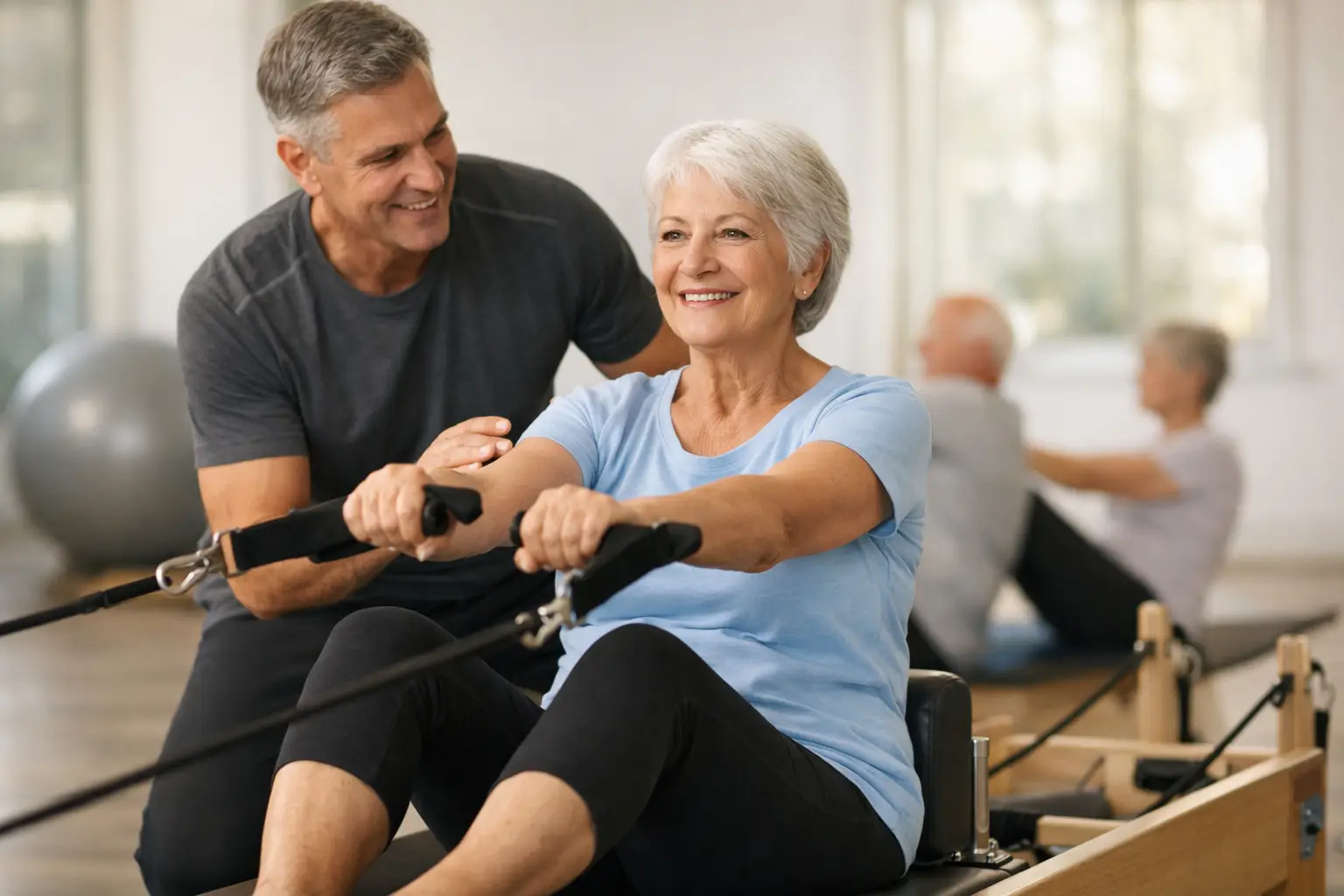
A reformer offers adjustable resistance and can support the body in lying, seated, kneeling, and standing positions. For some older adults, the moving carriage and straps make strength work feel smoother and more comfortable than unsupported mat exercises. For others, the equipment can feel unfamiliar, and getting on and off requires careful instruction.
A home reformer is a substantial purchase, not a requirement for successful Pilates. Before buying, consider the machine’s seat height, weight capacity, frame stability, carriage ride, spring system, footbar adjustments, storage needs, and whether there is enough clear space around it for safe entry and exit. A compact folding reformer may suit a smaller home, but folding designs can involve more setup and may not feel as stable or convenient for every user. Testing a reformer in a studio, if possible, often reveals more than specifications alone.
A Sustainable Home Routine
Consistency matters more than a long, occasional workout. Two or three sessions of 15 to 25 minutes can be a useful place to start, especially for someone returning to exercise. Allow time for a brief warm-up, a few focused movement patterns, and a calm finish rather than trying to cover every Pilates exercise at once.
A balanced routine might include breathing and posture awareness, seated or standing leg work, gentle spinal mobility, upper-body pulling or pressing, and a simple balance challenge near a counter or sturdy chair. The exact exercises should reflect the individual’s needs. Someone with knee discomfort may prioritize hip strength and avoid deep knee bends. Someone with limited shoulder range may use smaller arm movements and avoid overhead positions.
Keep the environment simple. Wear secure footwear or practice barefoot only on a nonslip surface. Remove loose rugs and cords. Keep a chair or counter nearby for standing work, and avoid exercising when unusually fatigued, lightheaded, or distracted by pain. These details are not overly cautious. They make a home routine easier to repeat with confidence.
Progress should be gradual. If a session leaves the body pleasantly worked and normal movement feels comfortable the next day, that is useful feedback. If pain increases, balance feels less steady, or symptoms persist, scale back and seek professional guidance rather than pushing through.
What a Good Instructor Should Help You Feel
The strongest senior Pilates instruction is neither overly cautious nor relentlessly demanding. It creates a clear path between those extremes. A good teacher explains the purpose of an exercise, offers a simpler version before it is needed, and treats a modification as a smart training choice rather than a lesser one.
Pilates can remain challenging at every age, but challenge should be specific. For one person, it may mean standing taller with less support. For another, it may mean building the leg strength to take stairs more comfortably or practicing enough trunk control to play on the floor with grandchildren. Better information leads to better Pilates choices, especially when the goal is to keep moving well in real life.
Start with the version of Pilates that feels manageable enough to repeat next week. That is often where meaningful strength, steadier balance, and lasting confidence begin.