A reformer can look deceptively simple: a moving carriage, a set of springs, and a few straps. Yet reformer spring resistance is one of the main reasons the same exercise can feel supportive for one person and overwhelming for another. Understanding what those springs do helps you choose appropriate settings in class, follow home workouts more confidently, and evaluate whether a reformer will suit your needs before you buy one.
Springs are not just a way to make Pilates exercises harder. They influence stability, feedback, range of motion, and how much control an exercise requires. More resistance is not automatically more advanced, and lighter resistance is not always easier.
What reformer spring resistance actually does
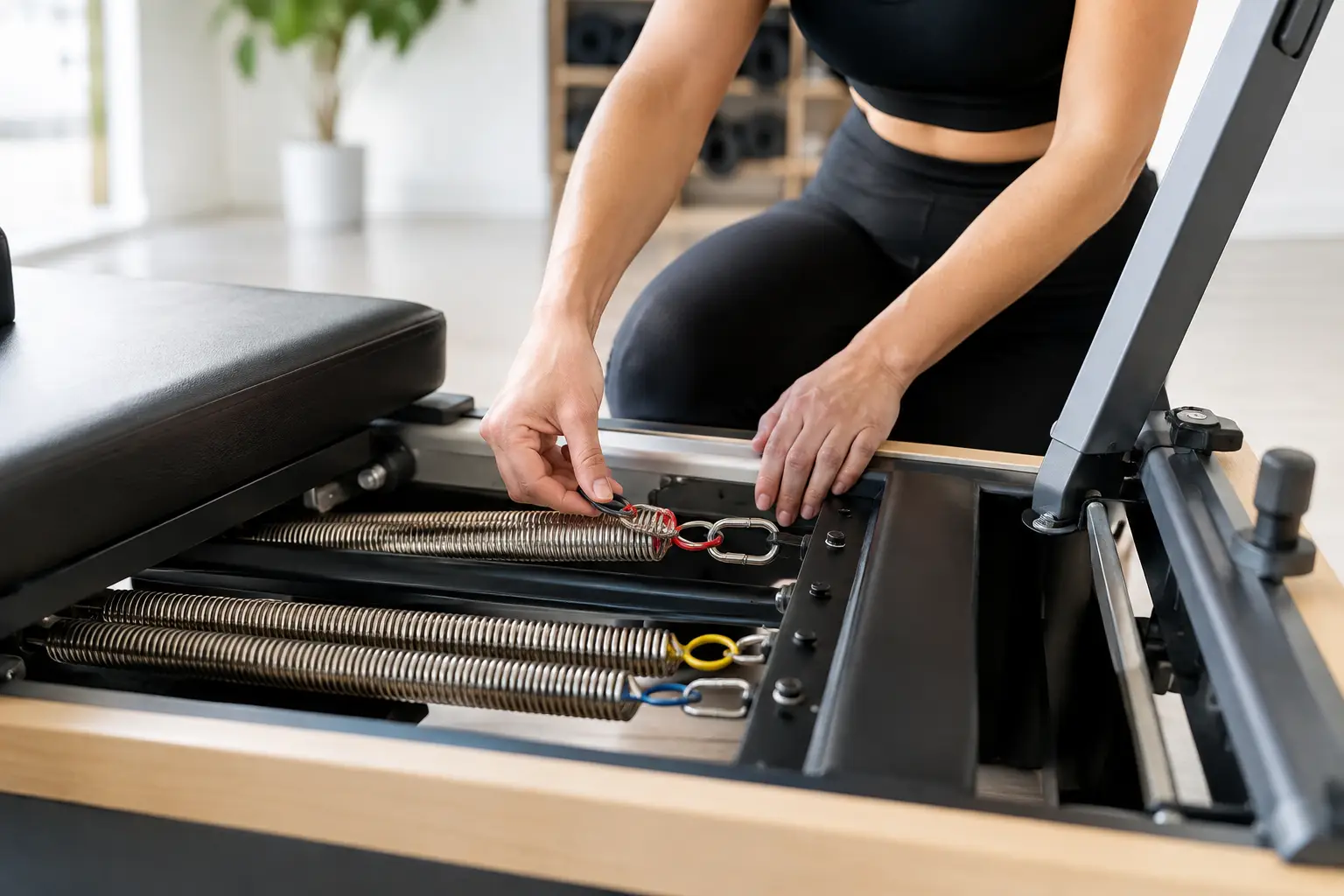
Reformer springs connect the carriage to the frame. As you push or pull the carriage away from its resting point, the springs lengthen and create tension that draws it back. The farther the carriage travels, the more resistance most springs create. This progressive tension is different from lifting a fixed dumbbell weight, which feels equally heavy whether your arm is at the beginning or end of its range.
That changing resistance can make movement feel smooth and responsive. On footwork, for example, heavier springs can give the legs something substantial to press into while keeping the carriage stable. During arm work, a lighter spring may demand more precise control because the carriage can move more easily.
Springs also provide information. If the carriage shifts unexpectedly, moves unevenly, or returns too quickly, you receive immediate feedback about your alignment and control. This is one reason Pilates teachers often describe springs as assistance and resistance at the same time.
Why light springs are not always easier
It is natural to assume a lighter spring setting is best for beginners. Sometimes that is true, particularly when learning a new movement or working with a smaller muscle group. But a low-resistance setting can make the carriage less stable. Without enough spring tension, the body has to manage a more mobile surface, which may be challenging for a new practitioner.
Consider standing or kneeling work. A heavier spring setting often creates a steadier carriage, making it more practical to focus on balance and position. On the other hand, using too much resistance can encourage gripping through the shoulders, hips, or lower back. The appropriate setting depends on the exercise, not just your experience level.
The same principle applies to rehabilitation-minded Pilates. A lighter spring may reduce load on a healing area, but it may also require more stabilization than the person can comfortably control. This is where individualized instruction matters, especially after surgery, during pregnancy, or when managing persistent pain.
Resistance changes the purpose of an exercise
A spring setting should support the goal of the movement. For lower-body pressing exercises such as footwork, moderate to heavier tension is common because it allows the legs to work against meaningful resistance. For shoulder mobility or arm coordination, lighter tension may be more appropriate so the upper body can move without strain.
Sometimes a teacher intentionally uses a spring that feels unexpectedly light or heavy to change the challenge. A lighter spring in a pulling exercise may ask for greater abdominal control. A heavier spring may help a beginner feel the pathway of a movement. Neither choice is universally better. The useful question is whether the setting lets you perform the exercise with control, breath, and sound alignment.
Spring colors are helpful, but not universal
Most reformers use color-coded springs, but there is no single industry-wide color system. A red spring on one brand may not match a red spring on another. Some manufacturers use different spring colors entirely, while others identify resistance by markings or labels.
That means a workout cue such as “use one red and one blue spring” should be treated as a starting point, not an exact prescription, if you are using a different reformer. The total tension can also change with spring length, hook position, carriage position, and the number of springs engaged.
When comparing reformers, look beyond the color chart. A manufacturer should clearly state the resistance level of each spring and explain compatible configurations. Better documentation is especially valuable for home users who will not have an instructor nearby to translate a studio sequence for their equipment.
How to choose a spring setting during practice
Begin with the setting recommended by a qualified instructor or the exercise source designed for your reformer. Then use your body’s response to decide whether the tension is serving you. You should be able to move the carriage deliberately, return it without a jolt, and maintain a steady breath.
A spring setting may be too heavy if you have to hold your breath, lock your joints, shrug your shoulders, or lose the intended range of motion. It may be too light if the carriage slides away before you are ready, wobbles during an otherwise stable exercise, or causes you to brace excessively through your neck and back.
Changing springs is not a failure or a shortcut. It is an adjustment that keeps the exercise matched to your current strength, coordination, and energy. A setting that feels right early in a workout may feel too demanding later, particularly when smaller stabilizing muscles are fatigued.
Start conservatively with unfamiliar movements
When trying a new exercise at home, use a setting that gives the carriage enough control without forcing the movement. Avoid copying an advanced instructor’s spring configuration simply because it appears in a video. Their reformer, body size, training history, and intended exercise variation may be different from yours.
For movements where you are standing, kneeling, or placing one foot on a moving carriage, err toward stability unless the instruction specifically calls for a lighter setting. Make changes one spring at a time so you can clearly feel what changed.
Reformer spring resistance and body size
Body size can affect how a reformer feels, but it should not be the only factor used to select springs. A taller person may need a different carriage position or strap length. A larger-bodied person may prefer more tension for certain exercises, while a smaller person may need more support in others. Strength, joint comfort, balance, mobility, and the exercise itself all matter.
Avoid the idea that one body type should always use a particular spring setting. Pilates is designed to be adaptable. Two people can use different configurations in the same class and still perform the same movement well.
What to consider when buying a home reformer
Spring resistance deserves close attention because it shapes nearly every part of the ownership experience. A low-cost reformer may provide only a limited range of tensions, which can restrict both beginner-friendly assistance and long-term progression. More springs do not automatically mean a better machine, but a thoughtful range of light, medium, and heavy options gives you more useful choices.
Check whether replacement springs are readily available and whether the brand provides clear maintenance guidance. Springs are wear items, not permanent parts. Over time, they can lose tension or show signs of corrosion, gaps, or deformation. Replace damaged or aging springs according to the manufacturer’s recommendations, and never use a spring that looks compromised.
Also consider the spring bar or gear bar design. A reformer that allows several secure attachment positions can offer meaningful flexibility, but only if the system is easy to understand and use correctly. For a first home reformer, clear markings and straightforward spring changes may be more valuable than a highly customizable setup that feels confusing.
Carriage quality matters alongside spring strength. Smooth wheels, a stable frame, and reliable fittings allow resistance to feel consistent. If the carriage sticks, rattles, or tracks unevenly, even a well-designed spring system will not feel as intended.
Use resistance to build a sustainable practice
The goal is not to keep adding tension until every exercise feels difficult. Pilates works best when resistance supports purposeful movement: enough challenge to build strength, enough assistance to learn well, and enough stability to move with confidence.
As your practice develops, revisit the settings you use most often. You may find that a spring that once felt heavy now helps you organize your movement, while a lighter setting reveals a new layer of control. That ongoing adjustment is part of a sustainable home practice – and a good reason to choose a reformer that can grow with you.