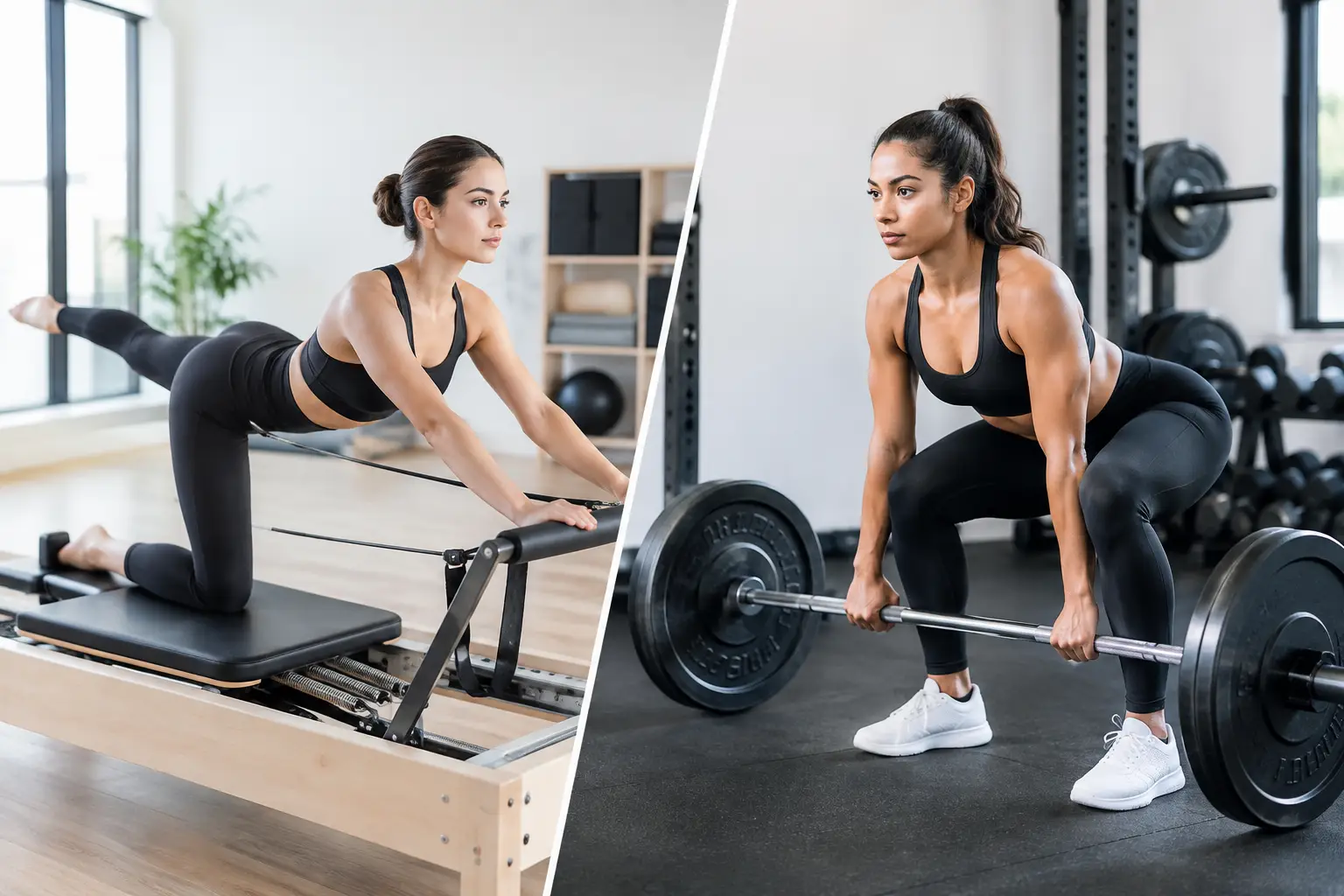
A reformer workout can leave your legs shaking after a controlled set of footwork. A weightlifting session can make the same muscles feel challenged through a heavy squat or deadlift. That overlap is why the Pilates reformer versus weightlifting question can feel confusing: both build strength, but they ask your body to develop it in different ways.
The better choice is rarely about which workout is more legitimate or more effective in the abstract. It is about the result you want, the movement experience you enjoy enough to repeat, and the practical realities of training at home. For many people, the most useful answer is not choosing one forever. It is understanding where each method excels so you can make a routine that supports your body and your life.
Pilates Reformer Versus Weightlifting: The Core Difference
Reformer Pilates uses a moving carriage, springs, straps, and bodyweight to create resistance. Exercises tend to emphasize controlled range of motion, alignment, coordination, breathing, and muscular endurance. The resistance can be substantial, especially with heavier springs and single-leg or unilateral work, but the challenge is usually delivered through precision as much as load.
Weightlifting uses external resistance such as dumbbells, barbells, kettlebells, cables, or machines. Its most direct purpose is progressive overload: gradually asking muscles to handle more weight, more repetitions, or more total work over time. That makes it especially efficient for building maximal strength and muscle mass.
Neither approach is automatically gentle or intense. A poorly chosen reformer exercise can aggravate a sensitive joint, while a well-coached strength routine can be highly adaptable for beginners. The meaningful distinction is the training emphasis. Reformer Pilates generally develops how well you control movement. Weightlifting generally develops how much external load you can produce and manage.
Which Is Better for Strength and Muscle?
If your primary goal is increasing muscle size or lifting heavier objects, weightlifting has the clearer advantage. Muscles respond to enough mechanical tension and a consistent progression in training demand. With weights, it is straightforward to track that progression: move from 15-pound dumbbells to 20-pound dumbbells, add a repetition, or add another set.
A reformer can still make you stronger. Springs provide variable resistance, and the machine allows challenging work for the legs, glutes, back, arms, and core. The carriage also creates an instability demand that requires the body to organize itself while moving. For someone new to structured exercise, reformer Pilates can produce noticeable strength gains, particularly in the lower body and trunk.
The limitation is that reformer resistance does not always offer the same upper ceiling as a barbell, heavy dumbbells, or a well-equipped gym. Spring tension varies by manufacturer, and a spring’s resistance changes as it lengthens. That is not a flaw. It is simply a different loading system. If building visibly larger muscles or maximizing bone-loading strength is central to your plan, weightlifting should be part of the picture.
For adults who want general strength, better body awareness, and a satisfying full-body workout, reformer Pilates may be enough on its own for a period of time. Progress will depend on exercise selection, spring settings, tempo, range of motion, and whether you continue to advance beyond familiar routines.
A note on bone health
Resistance training supports bone health because bones adapt to the forces placed on them. Weightlifting usually provides more measurable, high-load stimulus, especially through standing movements such as squats, deadlifts, presses, and loaded carries. Reformer Pilates can contribute, but much of the work is performed lying down, seated, or supported by the carriage.
For people concerned about bone density, particularly in midlife and beyond, a thoughtful strength program is worth discussing with a qualified clinician or trainer. Pilates can remain a valuable complement for movement quality, balance, and confidence.
Mobility, Posture, and Core Control
This is where the reformer has a distinct appeal. Its design can help you access movement with support rather than forcing range of motion. The footbar, straps, and adjustable springs offer feedback that many people find easier to understand than verbal cues alone. You can work on hip mobility, spinal articulation, shoulder control, and pelvic stability in a structured setting.
That does not mean weightlifting makes people stiff. Well-programmed strength training can improve mobility when lifts are performed through a comfortable, controlled range. A deep goblet squat, Romanian deadlift, split squat, and overhead press can all build usable mobility alongside strength.
The difference is in attention. Pilates tends to place posture, breath, trunk control, and movement precision at the center of every session. In weightlifting, those qualities matter, but the program may prioritize a performance outcome such as adding weight to the bar. If you spend long hours sitting, feel disconnected from how you move, or want a lower-impact entry point into exercise, reformer training often feels more approachable.
Consider Injury History and Recovery Needs
Neither method is a substitute for medical care, and neither is universally appropriate for every injury. Still, the reformer’s adjustable resistance and supported positions can make it useful when someone needs to rebuild confidence after a period of inactivity. The springs can assist certain movements, not just resist them, and the carriage can reduce the balance demands of standing exercises.
Weightlifting can also be modified effectively. Machines, lighter loads, reduced ranges of motion, and careful exercise selection can help people train around limitations. In fact, progressive loading is often an important part of restoring capacity. The key is matching the exercise to the person rather than assuming that all Pilates is safe or all weights are risky.
If you have osteoporosis, a recent surgery, persistent pain, pregnancy-related concerns, or a diagnosed joint or spinal condition, get individualized guidance before following generalized online workouts. A qualified Pilates instructor or strength professional should be able to explain why an exercise fits your needs and how to adjust it.
Home Setup, Cost, and Convenience
At home, the choice can come down to space and budget as much as fitness goals. A pair of adjustable dumbbells, resistance bands, and a bench can create a capable strength-training setup in a relatively small footprint. You can add weight incrementally, and the equipment is easy to use for many movement patterns.
A reformer is a larger purchase and a more specialized piece of equipment. Before buying, consider the frame, carriage travel, spring system, weight capacity, dimensions, vertical storage options, and whether it includes accessories you will actually use. A compact folding reformer may suit a multipurpose room, while a heavier studio-style model may offer a smoother carriage and a more planted feel for frequent practice.
The reformer’s value is not only in its components. For many owners, it removes friction. A machine that is ready in a dedicated corner of the home can make a 25-minute session far more likely than driving to a studio. But it is only a smart investment if you enjoy reformer work and have a realistic plan to use it consistently. Buying a premium machine will not solve a routine that does not fit your schedule.
Can You Combine Reformer Pilates and Weightlifting?
Yes, and for many people this is the most balanced approach. Weightlifting can provide the progressive loading needed for muscle, strength, and bone health. Reformer Pilates can reinforce control, mobility, coordination, and recovery-friendly movement. The combination is especially useful when your strength sessions feel productive but leave you wanting more attention to how your body moves.
A practical weekly rhythm might include two full-body strength sessions and two reformer sessions. Keep the reformer workouts lighter and mobility-focused around demanding leg days, or use them for upper-body and core emphasis when your lower body needs recovery. If your schedule only allows three workouts, one or two strength sessions plus one reformer session can still be a meaningful routine.
Pay attention to total fatigue rather than treating Pilates as automatically easy. Heavy reformer lunges, long plank sequences, and high-repetition leg work can challenge muscles that are already recovering from squats or deadlifts. Your plan should leave room for sleep, walking, and rest days.
How to Choose the Right Starting Point
Choose reformer Pilates first if you are drawn to low-impact training, want more guidance around alignment and control, or know that a structured home Pilates routine is the one you will maintain. It can be an excellent foundation for learning to move with more awareness.
Choose weightlifting first if your clearest goals are building muscle, becoming stronger in daily tasks, improving bone-loading exercise, or seeing objective progression in the numbers you lift. Start with manageable loads and prioritize good technique over chasing intensity.
If you feel equally interested in both, do not wait for a perfect answer. Begin with the option that is easiest to access consistently, then add the other method when your schedule, confidence, and budget allow. The most durable fitness plan is not the one that wins an online comparison. It is the one that gives you a stronger, more capable body and remains realistic enough to practice next week.