Standing on one foot to pull on a sock, stepping off a curb, reaching into a high cabinet – balance is part of ordinary life long before it becomes a fitness goal. So, can Pilates help balance? For many people, yes. Pilates can build several of the physical skills that support steadier movement: body awareness, trunk control, hip strength, ankle mobility, coordination, and the ability to adjust when your position changes.
That does not mean every Pilates class is automatically balance training, or that Pilates replaces a medical evaluation for new or worsening unsteadiness. Balance is a broad skill influenced by vision, inner-ear function, sensation in the feet, medications, joint health, strength, and confidence. Still, a well-chosen Pilates practice can be a practical, low-impact way to improve the movement quality that balance depends on.
Why balance is more than standing still
When people picture balance work, they often picture holding a single-leg pose without wobbling. That is one useful test, but daily balance is usually dynamic. It is the ability to stay organized while walking, turning, climbing stairs, carrying groceries, or catching yourself after a small misstep.
Your body manages that task through information and response. Your eyes, inner ear, joints, and feet tell your nervous system where you are in space. Your muscles then make quick, coordinated corrections. Stronger legs help, but strength alone is not the whole answer. You also need timing, joint control, and enough awareness to notice when your posture has drifted before it becomes a bigger correction.
Pilates is especially relevant because it asks you to pay attention to how you move, not only whether you finish a repetition. The method emphasizes controlled transitions, breathing, alignment, and stable positioning through the pelvis and rib cage. Those qualities can carry over to everyday movements that feel less predictable than an exercise sequence.
How Pilates can help balance
It improves trunk and pelvic control
A stable center gives the arms and legs a more reliable base from which to move. In Pilates, this does not mean bracing your stomach as hard as possible. Effective trunk control is responsive: the abdominal, back, diaphragm, and pelvic floor muscles work together to help you maintain position while breathing and moving.
For balance, that matters when one leg takes more load than the other. Consider walking uphill or stepping into a car. If the pelvis drops or rotates excessively, the supporting leg has to work harder to keep you upright. Pilates exercises that challenge pelvic stability – such as bridges, toe taps, side-lying leg work, and carefully taught tabletop variations – can improve control without requiring impact.
It strengthens the hips and legs that steady you
The glutes, deep hip muscles, quadriceps, hamstrings, calves, and muscles around the feet all contribute to balance. Hip strength is particularly useful for controlling the pelvis during single-leg support, which happens with every step you take.
Pilates often develops this strength through slower repetitions and a longer time under tension. Side-lying leg series, standing work, footwork, and split-stance exercises can reveal side-to-side differences that may be easy to miss in faster workouts. The goal is not simply to feel a burn. It is to build strength while keeping the knee, hip, ankle, and trunk aligned as the load changes.
It develops proprioception and coordination
Proprioception is your sense of where a body part is without having to look at it. It helps you place your foot accurately on a stair and adjust when the surface beneath you is uneven. Pilates encourages proprioception by using precise positions, controlled ranges of motion, and frequent attention to small adjustments.
At first, this can feel surprisingly challenging. A beginner may notice that one foot rolls inward, one hip lifts during a bridge, or the shoulders tense during leg work. These observations are useful information, not signs of failure. Over time, repeated practice can make it easier to recognize and correct those patterns before they interfere with stability.
It trains transitions, not just held positions
A balance exercise is most useful when it prepares you for movement. Pilates includes many transitions: rolling from the floor to sitting, changing from kneeling to standing, transferring weight between legs, and coordinating the arms and legs while the torso stays organized.
Moving slowly through these changes gives the nervous system time to learn. As skill improves, exercises can become more demanding through a smaller base of support, a longer lever, reduced hand support, or a more complex movement pattern. This gradual progression is one reason Pilates can suit people who want to improve balance without jumping immediately into high-impact or unstable-surface training.
Mat Pilates versus reformer Pilates for balance
Both mat and reformer Pilates can support balance, but they do it differently. Mat work is accessible and often asks more of your body awareness because the floor provides simple, consistent feedback. It can be an excellent place to learn breathing, alignment, bridges, quadruped work, side-lying strength, and controlled rolling patterns.
A reformer adds adjustable spring resistance, a moving carriage, and a footbar. Those features can make certain exercises easier to scale or more challenging to control. Footwork can build leg strength with the body supported, while standing or kneeling variations can introduce a meaningful coordination challenge once a person has the foundation for them.
The moving carriage is not automatically better for balance. It can be less appropriate when someone is very unsteady, anxious about falling, or still learning basic alignment. In those cases, a stable mat, a wall, or a sturdy chair may be the smarter starting point. If you are considering a reformer for home use, prioritize smooth carriage travel, secure footing, stable frame construction, and an appropriate spring range over novelty features. Equipment should make progressive practice safer and more practical, not pressure you into advanced exercises.
A realistic Pilates approach to better balance
Consistency matters more than making every workout a challenge. Two or three sessions a week can be enough to build familiarity and strength, particularly when you focus on quality rather than rushing through a long routine. Many people benefit from combining Pilates with regular walking, since walking adds real-world weight transfer and surface changes.
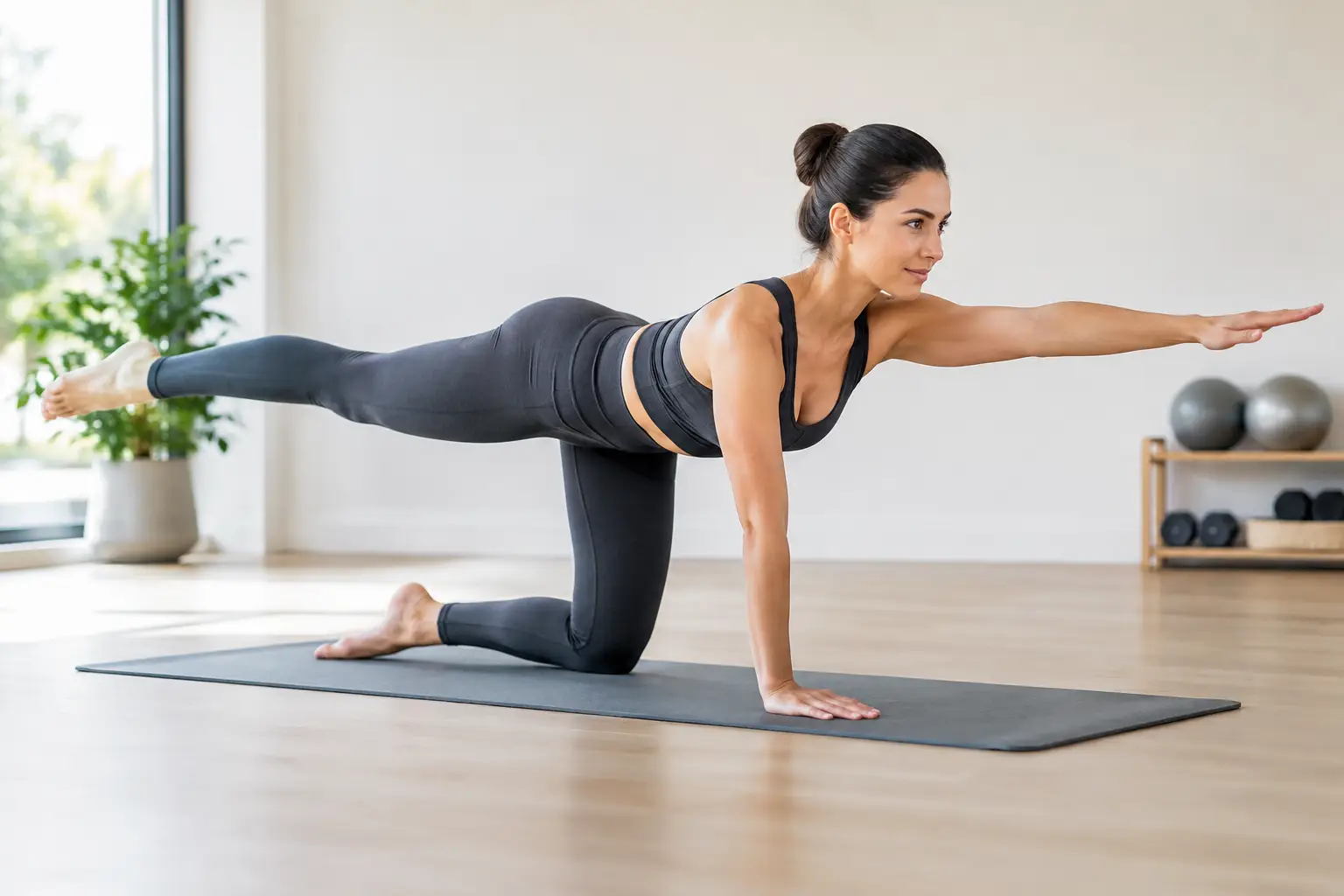
Start with movements that let you feel stable: supported standing work, bridges, heel raises, side-lying hip exercises, quadruped variations, and controlled sit-to-stands. As those become comfortable, add exercises that shift weight from one side to the other or reduce the amount of support you use. A countertop, wall, or chair is a useful training tool, not a shortcut.
Pay attention to the difficulty level. If you are gripping with your toes, holding your breath, or losing form repeatedly, the variation may be too advanced for productive balance training. A small wobble can be a normal learning signal. A sharp pain, dizziness, or a feeling that you may fall is a reason to stop and modify.
Who may need more than Pilates
Pilates can be part of a strong balance plan, but it is not a universal solution. Sudden balance changes, frequent falls, vertigo, numbness in the feet, fainting, or new weakness should be discussed with a health care professional. A physical therapist can help identify whether an issue is linked to the vestibular system, vision, medication effects, joint limitations, or a specific strength and mobility deficit.
People recovering from an injury or surgery may also need individualized guidance. In that setting, Pilates can still be valuable, but the right exercise selection and progression matter more than following a general online routine. The same is true for older adults who are new to exercise: supported work can be highly effective before single-leg or moving-carriage challenges are introduced.
What progress may look like
Better balance is not always dramatic. You may first notice that you feel less rushed getting dressed, more secure on stairs, or more aware of your posture during a long day on your feet. You might recover more easily from a small wobble rather than needing to grab for support.
That is the practical value of Pilates for balance. It teaches your body to create strength, control, and options within movement. Begin with a version of practice that feels safe enough to repeat, then let steady, well-organized sessions make everyday movement feel more dependable.
Leave a Reply
You must be logged in to post a comment.