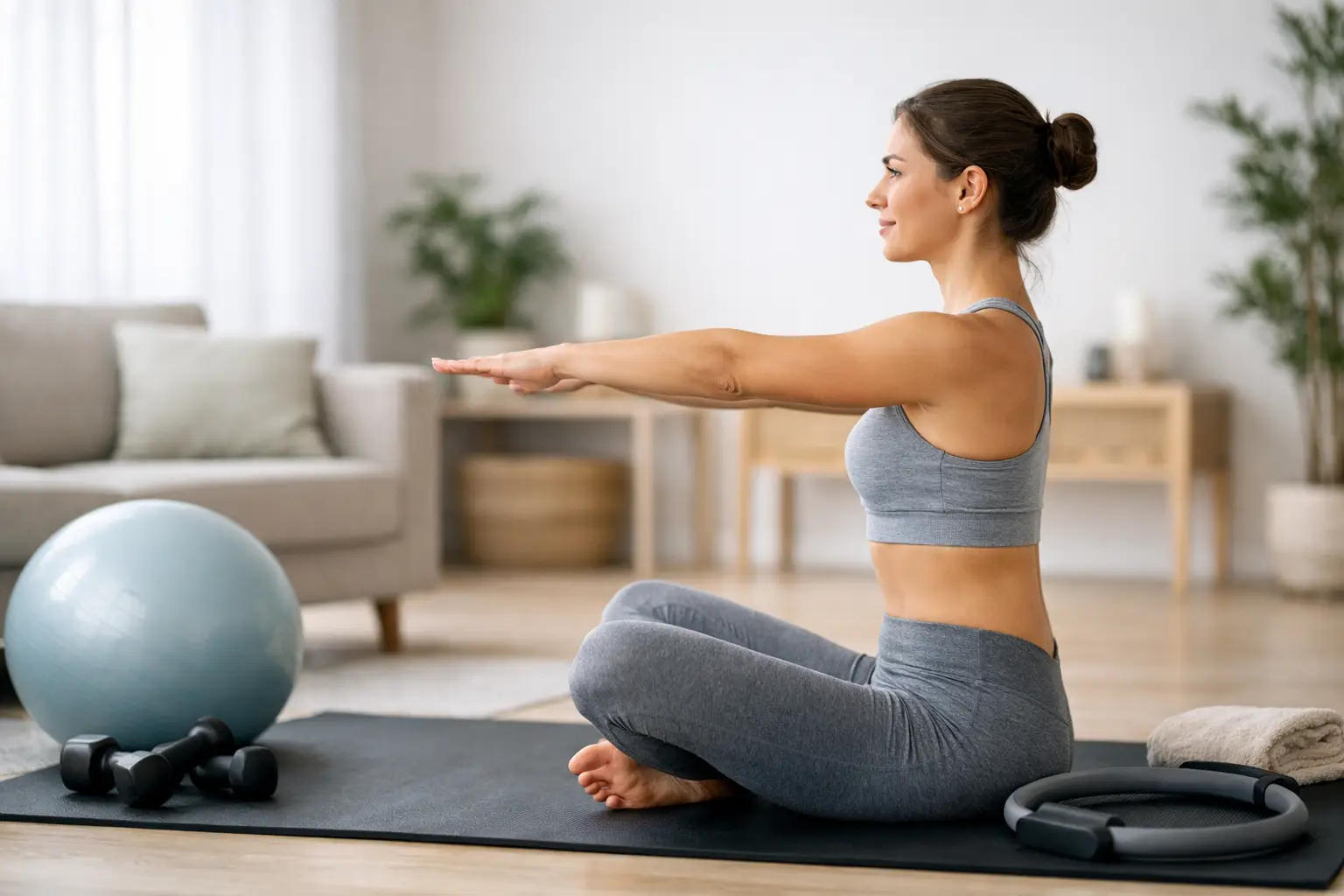
Your posture is not a pose you should force and hold all day. It is the changing relationship between your head, rib cage, pelvis, and feet as you work, walk, lift, rest, and move through life. Learning to improve posture through Pilates can help because the method trains those relationships together rather than asking you to simply pull your shoulders back.
For many people, posture concerns show up as a forward head at a laptop, rounded upper back, tight hip flexors, or an aching low back after standing. Pilates can be a useful part of the answer, but it is not a quick correction or a substitute for clinical care when pain, numbness, weakness, or a recent injury is involved. Its lasting value is that it builds awareness, strength, mobility, and control that you can use outside a workout.
Why Pilates can improve posture
Pilates is often described as core training, but that description is incomplete. A well-taught Pilates practice develops the deep abdominal muscles, back muscles, hips, shoulders, and breath mechanics that help your body organize itself during movement. Instead of isolating one area, exercises ask you to stabilize one part of the body while moving another with control.
That matters for posture. If your rib cage flares when you reach overhead, your neck may work harder than it needs to. If your pelvis is difficult to control as your legs move, your low back may take over. Pilates gives you repeated, lower-impact opportunities to notice these patterns and practice a different option.
It also avoids the common mistake of treating every posture issue as weakness. Some people need more upper-back strength; others need better thoracic mobility, a more comfortable workstation, more frequent movement breaks, or all three. Tightness is not always the problem, and stretching alone does not automatically create better alignment. Pilates is most useful when it helps you distinguish between what feels restricted, what feels unstable, and what habits are carrying over into daily life.
The posture skills Pilates actually trains
Neutral alignment without rigidity
Neutral spine is often misunderstood as a perfectly flat or fixed back. In Pilates, neutral generally means respecting your natural spinal curves while finding a balanced relationship between the pelvis and rib cage. You should still be able to breathe, turn, bend, and adapt.
On a mat, this may begin with lying on your back, knees bent, and noticing whether your ribs pop upward or your low back presses aggressively into the floor. The goal is not to eliminate every gap beneath the spine. It is to find a position where your abdominals can support you without gripping your glutes, holding your breath, or tensing your jaw.
This skill translates well to standing and sitting. Better posture often looks less like military stillness and more like a body that can stack comfortably, breathe fully, and make small adjustments before strain builds.
Deep core support and pelvic control
The deep core is not a belt you cinch as tightly as possible. Pilates uses coordinated abdominal support to help manage pressure and movement around the trunk. Exercises such as toe taps, marching, single-leg stretches, and controlled leg lowers can teach you to move your hips without repeatedly arching or twisting through the low back.
The right challenge depends on your current control. If a leg-lowering exercise causes your ribs to lift, your back to pinch, or your neck to strain, reducing the range of motion is not a failure. It is often the more productive choice. Control comes before complexity.
Upper-back strength and shoulder organization
Hours of phone and computer use can leave the chest feeling shortened and the upper back underused. Pilates can strengthen the muscles that help the shoulder blades glide and stabilize on the rib cage, including the mid-back and serratus anterior. Movements such as chest expansion, rowing patterns, breaststroke preparation, and carefully performed plank variations can be valuable here.
The cue is not simply “squeeze your shoulder blades.” Excessively pinching them together can make the neck stiff and limit natural shoulder movement. Think instead about broad collarbones, a long neck, and shoulder blades that sit supported rather than pulled down with force.
Hip mobility and glute strength
Posture does not stop at the waist. The hips influence how the pelvis and spine manage walking, stairs, standing, and exercise. Sitting for long periods can make the front of the hips feel limited, while underactive glutes may make it harder to control the pelvis during single-leg movement.
Bridges, side-lying leg work, kneeling hip extensions, and lunges can build useful hip strength when performed with steady pelvic alignment. Gentle hip-flexor mobility can complement this work, especially if you tend to stand with your low back arched. But avoid assuming that an anterior pelvic tilt is automatically wrong. Bodies vary, and the better goal is comfortable control, not forcing everyone into one silhouette.
How to improve posture through Pilates at home
A home routine does not need to be long to be effective. Consistency matters more than an occasional intense session, particularly when your goal is to change movement habits. Start with two or three sessions per week of 20 to 30 minutes, then use short reset practices on days when you spend more time sitting.
Begin each session with breath and body awareness. In a supported lying position or on hands and knees, breathe into the sides and back of your rib cage. Notice whether your shoulders creep toward your ears or whether your ribs move independently of your pelvis. This is not busywork. It gives you a reference point before more demanding exercises begin.
From there, choose a small sequence that includes spinal mobility, abdominal control, upper-back work, and hip strength. A practical session might include pelvic clocks, cat-cow, toe taps, bridges, side-lying leg lifts, swimming preparation, and a gentle chest-opening stretch. Move slowly enough to feel whether the effort is coming from the intended area.
Mat Pilates is enough for many beginners, and it is the simplest place to establish good technique. A reformer can add resistance, feedback, and exercise variety once you understand the fundamentals. For example, the footbar can support controlled leg work, while straps can challenge shoulder stability without requiring heavy free weights. However, a reformer does not automatically improve form. Spring resistance can either clarify an exercise or allow momentum and compensation, depending on the setup and instruction.
If you are considering a reformer for posture-focused home practice, prioritize adjustability and stability over accessory count. A secure frame, smooth carriage travel, appropriate spring options, and settings that fit your height will affect how confidently you can practice. The best equipment choice is the one that suits your space, budget, and willingness to use it regularly.
Cues that help, and cues to question
Pilates cues should make movement clearer, not make you feel more tense. “Lengthen through the crown of your head” can be helpful if it reduces neck compression. “Keep your ribs stacked over your pelvis” can help during standing work when it encourages a more supported trunk.
Be cautious with cues that demand constant correction. “Shoulders back and down” may be useful briefly, but holding the shoulders down all day can create unnecessary stiffness. “Tuck your tailbone” can help someone who is over-arching in a specific exercise, yet an aggressive tuck may flatten the natural curve of the low back and irritate some bodies.
Use sensation as feedback. You should generally feel muscular work, greater awareness, and perhaps mild effort. Sharp pain, tingling, dizziness, joint catching, or symptoms that worsen after practice are reasons to stop and seek guidance from a qualified healthcare professional or experienced Pilates instructor.
Make your daily environment support the work
Pilates sessions cannot fully offset a workday spent in one position. If you sit for long stretches, place your screen at a height that does not require a sustained downward gaze, support your feet, and change positions regularly. A costly ergonomic setup is not always necessary, but the ability to move is.
Try connecting a brief Pilates reset to an existing habit: after a video meeting, stand and practice a few supported roll-downs; after lunch, take a short walk; before bed, use calm breathing and thoracic rotation instead of another prolonged scroll. These small transitions give your body more variety, which is often more valuable than chasing a single “perfect” posture.
Progress is usually measured in ordinary moments: less neck tension during computer work, more ease standing in line, a stronger bridge, or the ability to reach overhead without your ribs thrusting forward. Let Pilates help you build those quieter forms of support. A posture that feels adaptable, strong, and sustainable is a far better goal than one you have to hold in place.