
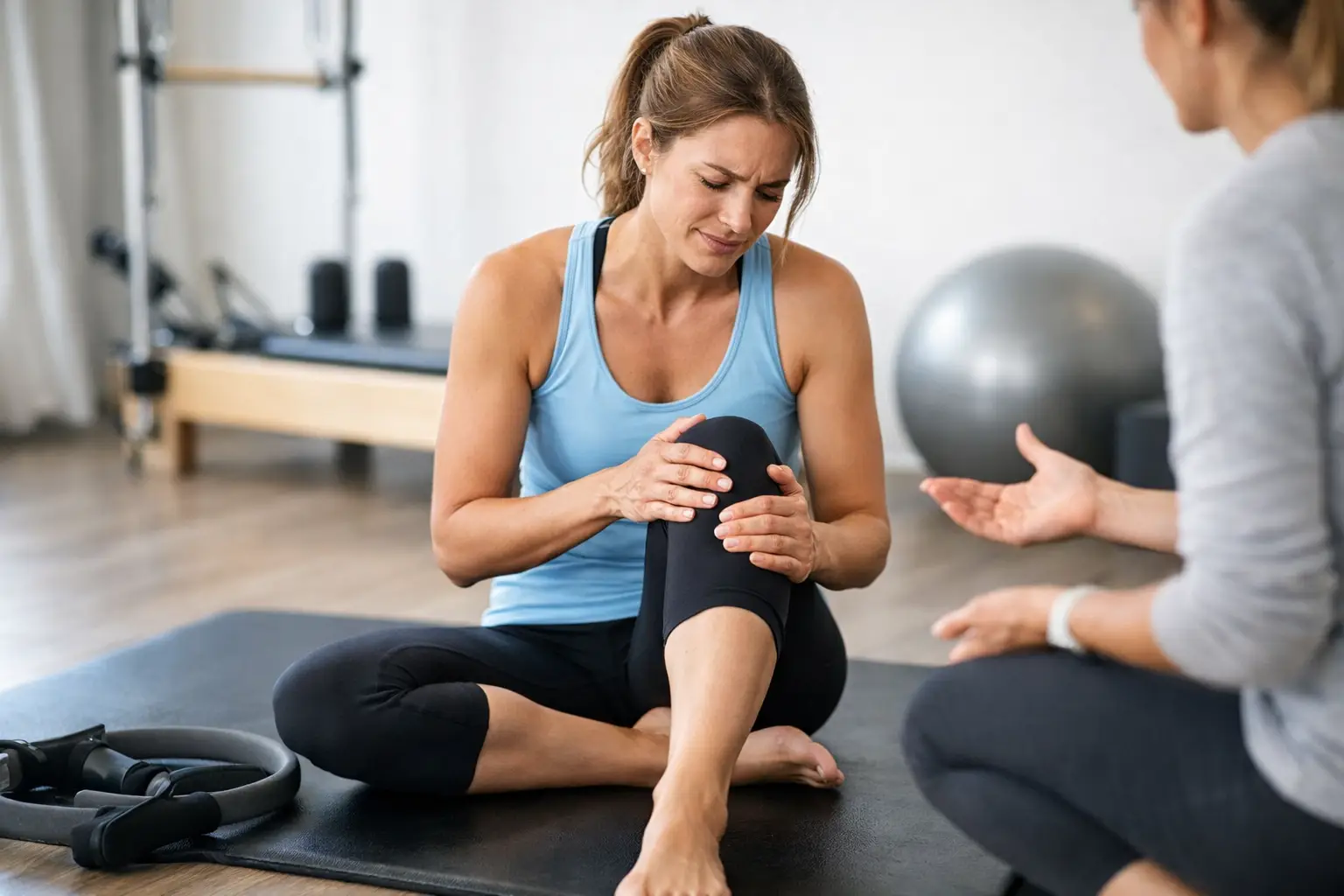
A knee that complains during footwork, lunges, or kneeling work can make an otherwise encouraging Pilates routine feel uncertain. Pilates knee pain is not something to push through as a test of commitment. It is useful feedback: the movement, resistance, range of motion, or setup may not currently match what your knee can tolerate.
The reassuring part is that Pilates is highly adaptable. A thoughtful adjustment can often keep you moving while reducing irritation. The less reassuring part is that there is no universal fix. Knee pain can relate to technique, a recent increase in activity, old injuries, hip or ankle limitations, or a condition that deserves medical assessment. The goal is to understand the pattern before deciding whether to modify, rest, or get professional help.
Why Pilates knee pain can happen
The knee is designed to bend and straighten while being supported by the foot, ankle, hip, and surrounding muscles. When one part of that system is not contributing well, the knee may take on more force than it should. Pilates often reveals these gaps because its slower pace and controlled repetitions make alignment demands more visible.
A common issue is the knee drifting inward during a squat-like movement, standing lunge, side split, or reformer footwork. This can happen when the hip is not maintaining its position, the feet are placed too narrowly, or the resistance is beyond the level a person can control. The answer is not always to force the knees farther apart. Instead, reduce the range, slow down, and aim to have each kneecap generally track in the same direction as the middle toes.
Too much range can also be a problem. Deep knee bending is not automatically harmful, but it requires sufficient control and comfort. If pain appears only at the bottom of a squat, in a deeply bent reformer carriage position, or when kneeling back toward the heels, your current range may be more than the joint is ready for. Working in a smaller, pain-free range is a legitimate training choice, not a lesser version of the exercise.
Load matters as much as alignment. On a reformer, heavier springs can create a misleading sense of support. For footwork, more resistance may feel stable, but it also asks the legs to produce and absorb more force. Conversely, springs that are too light can make the carriage feel unstable and require more control than expected. The best setup is the one that allows a smooth carriage return without locking the knees, twisting the feet, or bracing through pain.
The movement patterns worth checking first
Before assuming the knee itself is the problem, look at what happens immediately above and below it. A few simple observations can make Pilates knee pain easier to interpret.
Foot placement and ankle mobility
On reformer footwork, place the feet symmetrically and use a position you can maintain without gripping the toes or rolling toward the outer edges of the feet. A footbar that is too high, low, or far away for your proportions can change the angle at the knee. This is one reason equipment setup deserves attention, particularly on home reformers with limited adjustment options.
Restricted ankle motion can also shift load upward. If the heels lift early, the feet turn out to find range, or the arches collapse as you bend the knees, try a shallower bend and a more stable foot position. Calf tightness, footwear, and individual anatomy can all play a role. There is no prize for keeping the heels down if doing so causes discomfort elsewhere.
Hip and pelvic control
The hips help guide the line of the leg. During bridges, squats, side-lying leg work, and standing reformer exercises, notice whether one side of the pelvis drops or rotates as the knee bends. A smaller movement with a level pelvis is usually more productive than a larger movement that sends force into the knee.
For some people, knee discomfort during leg circles or side-lying work is not caused by the knee position at all. It can come from lifting the leg too high, turning out beyond available hip range, or allowing the thigh to roll inward as fatigue builds. Resetting the pelvis and shortening the lever often changes the exercise immediately.
Locked knees and forceful returns
Pilates cues sometimes emphasize straight legs, but straight does not mean aggressively locked. Snapping the knee straight at the end of reformer footwork, standing work, or jumpboard drills can be irritating, especially for people with joint hypermobility or a history of knee injury. Reach full length with control, then begin the return before the joint is forced into its end range.
The carriage should return quietly. If it crashes into the stopper or you must pull yourself in with the knees, adjust the springs, reduce speed, or shorten the motion. That is both a comfort issue and a practical equipment-safety issue in a home practice.
How to modify Pilates without abandoning your routine
Pain-free movement is the starting point. Mild muscle effort or temporary stiffness is different from sharp, catching, swelling, or escalating joint pain. During an exercise, use a simple rule: discomfort should stay low, should not worsen rep by rep, and should settle soon after you stop. If it does not, the exercise needs a different version or a break.
Start by reducing one variable at a time. Make the range smaller, lower the resistance, remove impact, or choose a more supported position. For example, if traditional reformer footwork hurts, try fewer repetitions, avoid the deepest bend, and use a spring setting that gives you control without requiring a forceful push. If kneeling work bothers the front of the knee, add cushioning, place less body weight on that knee, or substitute a seated or side-lying exercise that trains a similar pattern.
Mat Pilates offers useful alternatives when a loaded standing or kneeling movement is not comfortable. Bridges with the feet positioned closer or farther from the body, depending on comfort, can train the posterior chain with less knee bend. Side-lying glute work, dead bug variations, and carefully controlled core work can maintain consistency while you sort out the aggravating movement.
Do not assume that a more expensive reformer automatically solves a knee issue. Better carriage travel, a stable frame, adjustable footbar positions, and a smooth spring system can make modifications easier, but no equipment feature replaces appropriate programming. When assessing a reformer for home use, consider whether its footbar, shoulder rests, rope lengths, and spring resistance offer enough adjustment for your body and current needs. A machine that encourages a compromised setup is not a good long-term value, even if it is compact or attractively priced.
When to pause and seek professional guidance
A qualified Pilates instructor can help identify obvious setup and technique issues, particularly if pain appears in a specific exercise. A physical therapist, sports medicine clinician, or other licensed health professional is the better next step when symptoms are persistent, significant, or difficult to explain. They can assess factors that a general movement screen cannot, including injury history, joint stability, swelling, and tolerance for loading.
Stop the aggravating exercise and seek timely clinical advice if you have:
- noticeable swelling, warmth, redness, or bruising around the knee
- a pop at the time of injury, inability to bear weight, or a knee that gives way
- locking, catching, or an inability to fully bend or straighten the joint
- pain that persists at rest, wakes you at night, or steadily worsens despite reducing activity
If you have recently had knee surgery, an acute injury, or been diagnosed with arthritis, tendinopathy, or a ligament condition, individualized guidance is especially worthwhile. Pilates may still be appropriate, but the right movements, resistance, and progression depend on your specific situation.
Build back gradually
Once a movement is comfortable, resist the urge to return immediately to your previous volume. Add range, repetitions, resistance, or complexity gradually rather than all at once. Keep track of how the knee feels later that day and the next morning. Delayed soreness can be useful information about whether the session was tolerable, while worsening joint pain is a signal to scale back.
A sustainable Pilates practice should leave you feeling more capable, not increasingly guarded around a familiar movement. Give the knee a clear, manageable task, choose a setup that supports good control, and let comfort guide the pace of progress. Better information leads to better Pilates choices, especially when your body is asking for a more careful one.