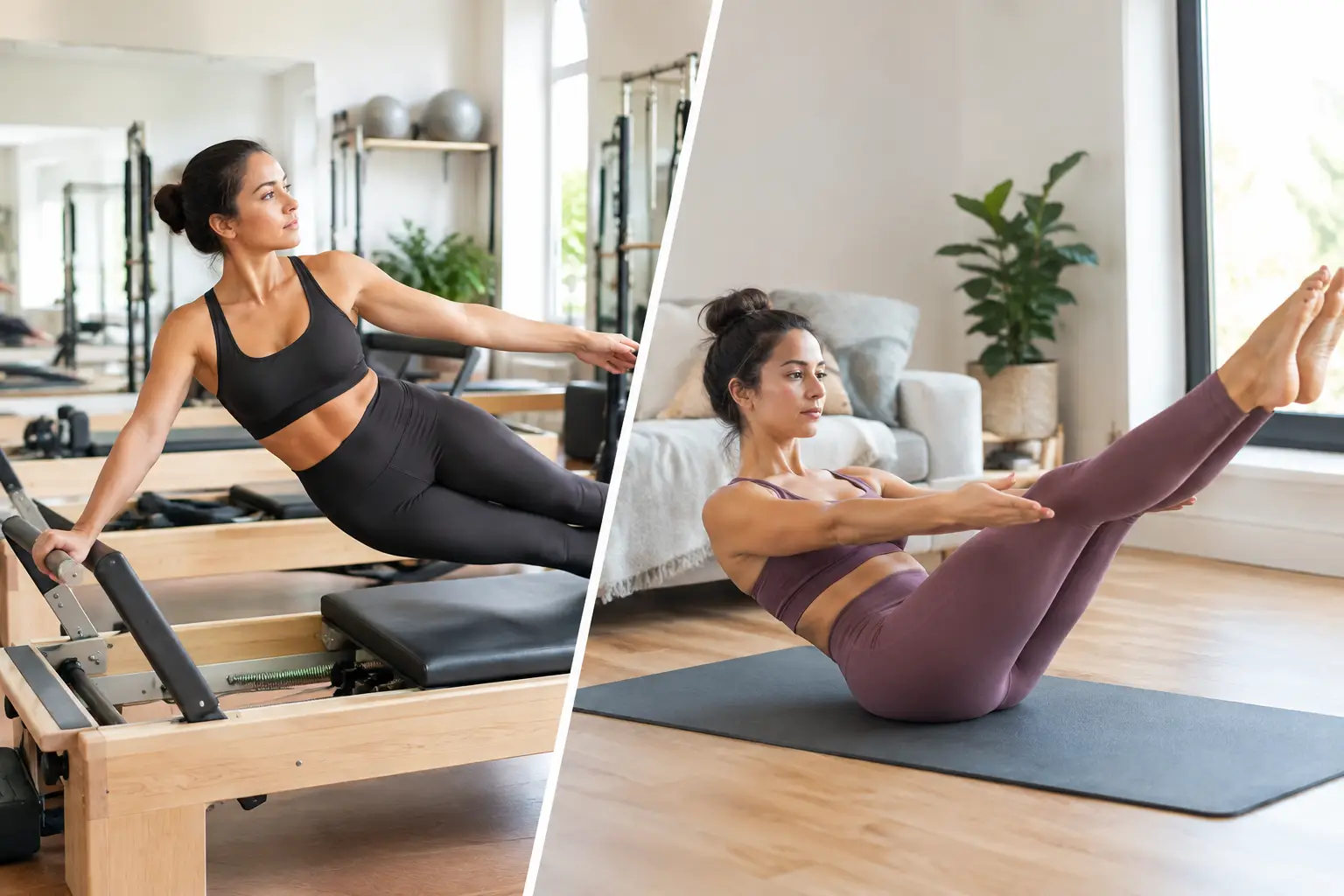
A Pilates studio versus home decision is rarely about which option is objectively better. It is about where you are most likely to receive the instruction you need, practice often enough to feel progress, and spend money in a way that supports your real life. A beautiful studio membership is not useful if scheduling makes you miss classes. A home reformer is not a bargain if it becomes an expensive clothes rack.
For many people, the strongest Pilates routine includes both settings at different stages. Studio classes can build skill and confidence; home practice can make that skill easier to repeat. The right balance depends on your experience, physical needs, available space, budget, and preference for structure.
Pilates Studio Versus Home: The Core Difference
The studio experience is guided, social, and equipment-rich. You reserve a time, arrive at a dedicated space, and work under an instructor who can observe your movement in real time. Depending on the studio, you may use reformers, chairs, towers, barrels, and small props that would be impractical to own at home.
Home Pilates is private, flexible, and highly personal. You can complete a 15-minute mat session before work, repeat a short mobility sequence between meetings, or use a home reformer whenever your schedule allows. The tradeoff is that you are responsible for choosing appropriate workouts, setting up your equipment correctly, and noticing when a movement does not feel right.
Neither environment guarantees better results. Consistent practice, sound technique, progressive challenge, and a routine you can sustain matter more than the location alone.
When a Pilates Studio Is Worth the Cost
A studio is often the clearest starting point for beginners, particularly those who are drawn to reformer Pilates but have little movement experience. The reformer looks straightforward at first glance, yet its carriage, springs, straps, footbar positions, and moving platform create variables that affect every exercise. In-person instruction helps you learn how to set up safely and use resistance with intention rather than simply making it heavier.
Good instructors also provide feedback that is difficult to replicate through a video. They may notice that you are gripping through your hip flexors, shifting weight into one side, holding tension in your neck, or moving your spine too aggressively to compensate for limited mobility. Those small corrections can make an exercise more effective and more comfortable.
Studios can also be valuable when you need external accountability. A booked class creates a commitment. Some people thrive when an instructor sets the pace and a group setting removes the need to decide what workout to do. If your home is busy, small, or associated with work and caregiving, leaving the house may help Pilates feel like protected time rather than another task competing for attention.
The limitation is cost. In major US cities, regular reformer classes can quickly become a meaningful monthly expense, especially if you prefer private sessions or small-group instruction. Class schedules may be restrictive, and the quality of teaching can vary widely. A polished studio, energetic music, and a full class do not automatically mean the programming is appropriate for your body or goals.
Before committing, consider whether the studio offers an introductory class, private assessment, or beginner series. Ask about class size, instructor training, and whether sessions emphasize form rather than speed alone. If you have persistent pain, recent surgery, pregnancy-related considerations, or a medical condition affecting movement, seek guidance from an appropriately qualified health professional and choose instructors who are comfortable working within those boundaries.
When Home Pilates Makes More Sense
Home practice is compelling because it removes friction. There is no commute, no late-cancellation policy, and no need to fit a 50-minute class into a day that only has 25 minutes available. That access can be especially useful for building the frequency Pilates responds well to. Short, focused sessions performed several times a week can be more productive than an ambitious class plan that rarely happens.
Mat Pilates has the lowest barrier to entry. A supportive mat and enough floor space to lie down with your arms and legs extended are enough to begin. Small accessories such as resistance bands, a Pilates ring, light hand weights, or a soft ball can add variety without requiring a dedicated workout room.
A home reformer changes the equation. It can offer smoother resistance, more exercise options, and a closer approximation of studio training, but it is a purchase that deserves careful thought. Measure the usable space, not just the machine footprint. You need room to get on and off the carriage, extend the straps, and move safely around the frame. Ceiling height can matter for standing work or tower attachments, while flooring may matter for stability and noise.
Equipment quality also affects the ownership experience. A well-built reformer generally offers a stable frame, a carriage that glides consistently, secure spring attachment points, adjustable components, and a resistance range that will remain useful as you become stronger. Lower-priced folding models can be practical for limited space, but they may have fewer adjustments, a lighter feel, or a carriage experience that does not suit every user. Portability is valuable only if you will truly store and unfold the machine regularly.
The main challenge at home is self-direction. Without feedback, it is easy to rush, choose familiar movements only, or mistake fatigue for effective form. Beginners can reduce that risk by starting with foundational mat instruction or a small number of studio sessions before relying on independent reformer workouts. Recording your form occasionally, working from clear beginner programming, and progressing one variable at a time can also make home training more deliberate.
Compare the Real Cost, Not Just the Price Tag
Studio memberships and home equipment ask for money in different ways. A studio plan is an ongoing operating cost. You may pay monthly, per class, or through packages that expire. Home practice often has a lower ongoing cost, but a reformer requires a larger upfront investment, plus possible delivery, assembly, accessories, maintenance, and eventual replacement parts.
A useful comparison starts with your likely frequency, not your ideal frequency. If you attend two studio classes every week for a year, the annual total may approach or exceed the cost of some home reformers. If you realistically attend twice a month, ownership may take much longer to justify financially. The same principle applies to digital memberships: an affordable subscription still has little value if you do not use it.
It also helps to put a value on convenience without overstating it. A home setup can save travel time and make frequent practice possible. A studio can provide expert eyes, equipment variety, and a change of environment that keeps you engaged. Those benefits are not interchangeable, so the cheapest option is not always the best value.
A Hybrid Approach Often Delivers the Most Value
For many practitioners, the decision is not Pilates studio versus home forever. It is studio first, home later, or home most days with periodic studio check-ins. This approach can be especially sensible for someone buying a first reformer.
A few foundational sessions can teach you how springs alter resistance, how to position your body on the carriage, and how to recognize appropriate effort. Once you are comfortable, a home routine makes it easier to practice the basics frequently. Returning to a studio occasionally can refresh your programming, introduce new apparatus, and catch habits that have developed over time.
A hybrid plan also prevents a common purchasing mistake: buying equipment to solve a consistency issue that is actually caused by unclear goals. Try a short period of structured home mat practice first. If you enjoy the method, use it regularly, and want more resistance and exercise variety, a reformer may be a meaningful next step rather than an impulse purchase.
Choose the Setting That Supports Your Next Six Months
Ask yourself practical questions. Do you need hands-on coaching to feel safe and confident? Is your schedule predictable enough for booked classes? Do you have a quiet, usable area at home? Will a home reformer be accessible, or stored somewhere inconvenient? Are you motivated by privacy or by community?
Your answers may change as your Pilates experience changes. A beginner who needs instruction today may become a confident home practitioner later. Someone with a well-equipped home gym may still benefit from a studio class when they want expert progression or a more focused session.
The best choice is the one that makes Pilates easier to return to. Build around the space, support, and level of guidance that help you move with attention now, then let your routine evolve as your confidence grows.