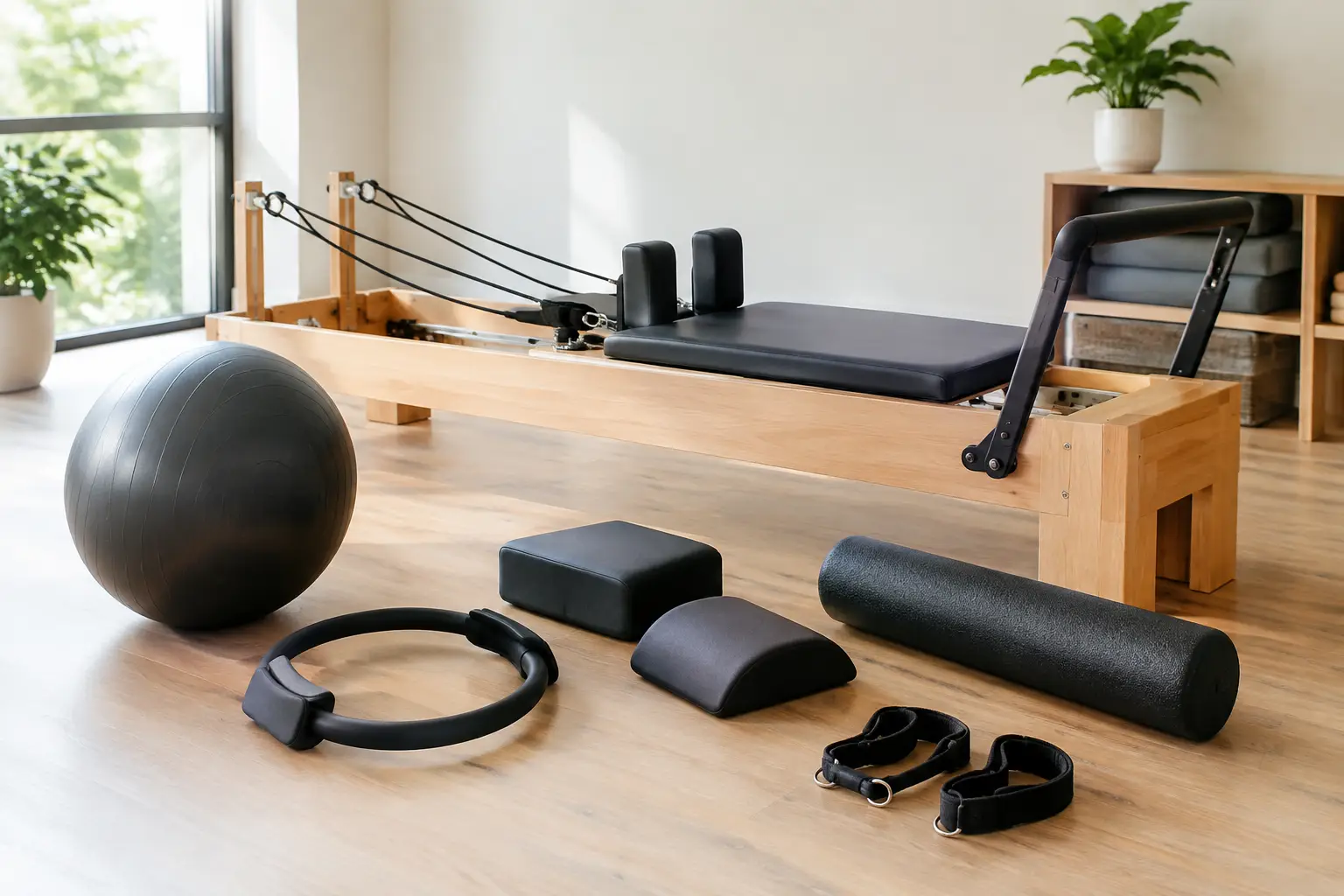
A home reformer can arrive with a long list of included parts, optional upgrades, and accessories sold separately. That does not mean you need all of them. This reformer accessories guide focuses on the pieces that meaningfully affect comfort, exercise variety, and safe long-term use, so you can build a setup that fits your body and practice rather than buying accessories that spend most of their time in a closet.
The right choices depend on the reformer you own, the programming you follow, and how you plan to use it. A beginner who wants a consistent full-body routine has different needs from an experienced practitioner adding athletic conditioning or rehabilitation-informed work at home. Start with the equipment that supports good movement, then expand only when an accessory has a clear purpose.
Start With What Your Reformer Already Includes
Before ordering anything, read the product manual and take inventory. Many home reformers already include a box, jumpboard, platform extender, standing platform, foot strap, shoulder rests, ropes or straps, and a removable riser or pulley system. In some cases, an accessory described as an upgrade is simply a replacement part or a version designed for a different model.
Compatibility matters more than it may seem. A jumpboard must lock securely into the footbar area. A box should sit stably on the carriage and be sized for the machine’s width. Ropes, loops, and pulley components need to match the manufacturer’s attachment system. A universal-looking accessory can create an awkward fit, limited carriage travel, or a safety issue if it shifts during use.
It is also worth distinguishing between accessories that change what you can do and accessories that make existing exercises more comfortable. Both can be valuable, but they solve different problems. If your goal is to broaden your practice, prioritize equipment that expands exercise options. If you already have a well-rounded routine but avoid certain positions because of pressure or discomfort, comfort upgrades may be the better use of your budget.
The Reformer Accessories That Matter Most
A sturdy Pilates box
For many home users, a short box is the most useful accessory beyond the reformer itself. It creates height and support for seated work, prone extension exercises, side-lying movements, and exercises that challenge balance and trunk control. It also makes the reformer more adaptable for people with limited hip mobility or difficulty getting into low positions.
Box size is not a minor detail. A box that is too narrow, too tall, or poorly matched to the carriage can make exercise setup feel unstable. Check your reformer’s specifications before buying, particularly if you are considering a non-brand option. If you have the choice between a well-fitted box and several small accessories, the box will usually offer more practical value.
A jumpboard for low-impact cardio
A jumpboard converts the carriage into a supported jumping surface. With your back supported on the carriage, you can practice controlled jumping patterns that challenge leg strength, coordination, and cardiovascular endurance with less impact than floor-based jumping.
It is a useful option for people who enjoy a more energetic workout, but it is not essential for every home practice. Good jumping mechanics still require adequate core control, hip and knee alignment, and appropriate spring resistance. If you are new to reformer work, learn foundational footwork first. The jumpboard is most rewarding when it builds on a stable base rather than replacing one.
A platform extender or mattress converter
A platform extender fills the space between the carriage and frame on compatible reformers. It can make certain kneeling, standing, and long-body positions feel more secure, while also creating a more usable surface for mat-style movement. Some brands offer padded converter mats that turn the reformer into a raised exercise platform.
This accessory is especially practical in a small home where one piece of equipment needs to support several kinds of training. It can also help practitioners who prefer a higher surface for stretching, mobility work, or transitions. Still, it is a convenience purchase, not a requirement for effective reformer Pilates.
A foot strap or ankle strap
A foot strap supports exercises performed while seated on the box or facing away from the footbar. It can help anchor the lower body during short-box abdominal work, hip mobility exercises, and certain rowing variations. Some reformers include one as standard equipment, while others offer it separately.
Look for a strap that is easy to adjust and remains firmly secured under tension. If the strap position is not right for your height, forcing the setup can pull you out of alignment. A well-designed accessory should make an exercise more accessible, not encourage you to work around an unstable configuration.
Replacement loops and handles
Soft loops, padded handles, and adjustable straps are easy to overlook until the originals wear down or feel uncomfortable. They affect how your hands and feet connect to the resistance system, so their quality can influence grip, comfort, and confidence during movement.
This is one area where replacement may be more important than upgrading. Inspect ropes, clips, stitching, and loops regularly for fraying, cracks, or stretching. Choose parts designed for your reformer whenever possible. A low-cost replacement is not a good value if it compromises the security of a moving system.
Comfort Accessories: Helpful, but Not Always Necessary
Some accessories are less about expanding the repertoire and more about helping you practice consistently. A non-slip reformer mat can protect the upholstery from sweat, sunscreen, and pet hair, particularly in a shared living space. It should lie flat and stay in place without changing the feel of the carriage.
A small headrest pad can be helpful for a person with a sensitive neck, but it should be used thoughtfully. Adding too much height under the head can place the neck in excessive flexion, especially in exercises where the headrest is already raised. For the same reason, thick cushions and improvised pillows are not a substitute for adjusting the reformer correctly.
Grip socks can be worthwhile for hygiene and traction, particularly if you practice barefoot only occasionally or share your equipment with family members. Select a pair with silicone grips across the sole rather than a few small dots that wear down quickly. They are optional, however. Bare feet are appropriate for many reformer exercises when the environment is clean and the movement is controlled.
What to Skip Until You Need It
Accessory bundles can make a new reformer feel incomplete, but more equipment does not automatically create a better practice. Resist buying specialty props before you know how often you will use them. Pilates rings, weighted balls, resistance bands, and sliders can add variety, yet they are generally easier to introduce later than core reformer components.
The same caution applies to decorative storage solutions and oversized equipment organizers. If your reformer folds or lives in a multipurpose room, storage may be a real priority. Otherwise, a simple bin for loops, cleaning supplies, and small props is often enough. Spend first on a stable reformer setup and adequate clear floor space around it.
Avoid accessories that encourage unsupported variations or promise to make a home reformer function like a studio apparatus. A reformer is versatile, but it is not interchangeable with every piece of Pilates equipment. If an add-on changes the machine’s intended structure, blocks safety features, or has unclear installation instructions, it is reasonable to pass.
Build Your Setup Around Your Actual Practice
A useful way to make decisions is to identify the friction point in your current routine. If you want more exercise variety, a box may be the answer. If you miss the energy of studio jumpboard classes, consider a compatible jumpboard. If your challenge is fitting movement into a busy schedule, a protective mat and organized storage may do more for consistency than another specialty prop.
Also consider the cost of ownership. Branded accessories often cost more, but they typically provide the best fit, clear setup instructions, and access to replacement parts. Third-party options can be sensible for simple items such as grip socks or cleaning supplies. For load-bearing parts, moving attachments, and model-specific equipment, compatibility and construction should carry more weight than a lower price.
A thoughtful home setup does not need to look like a fully stocked studio. The best accessories are the ones that make Pilates easier to practice safely, comfortably, and often. Give yourself time to learn how your reformer works, then let your routine show you what is genuinely worth adding.