
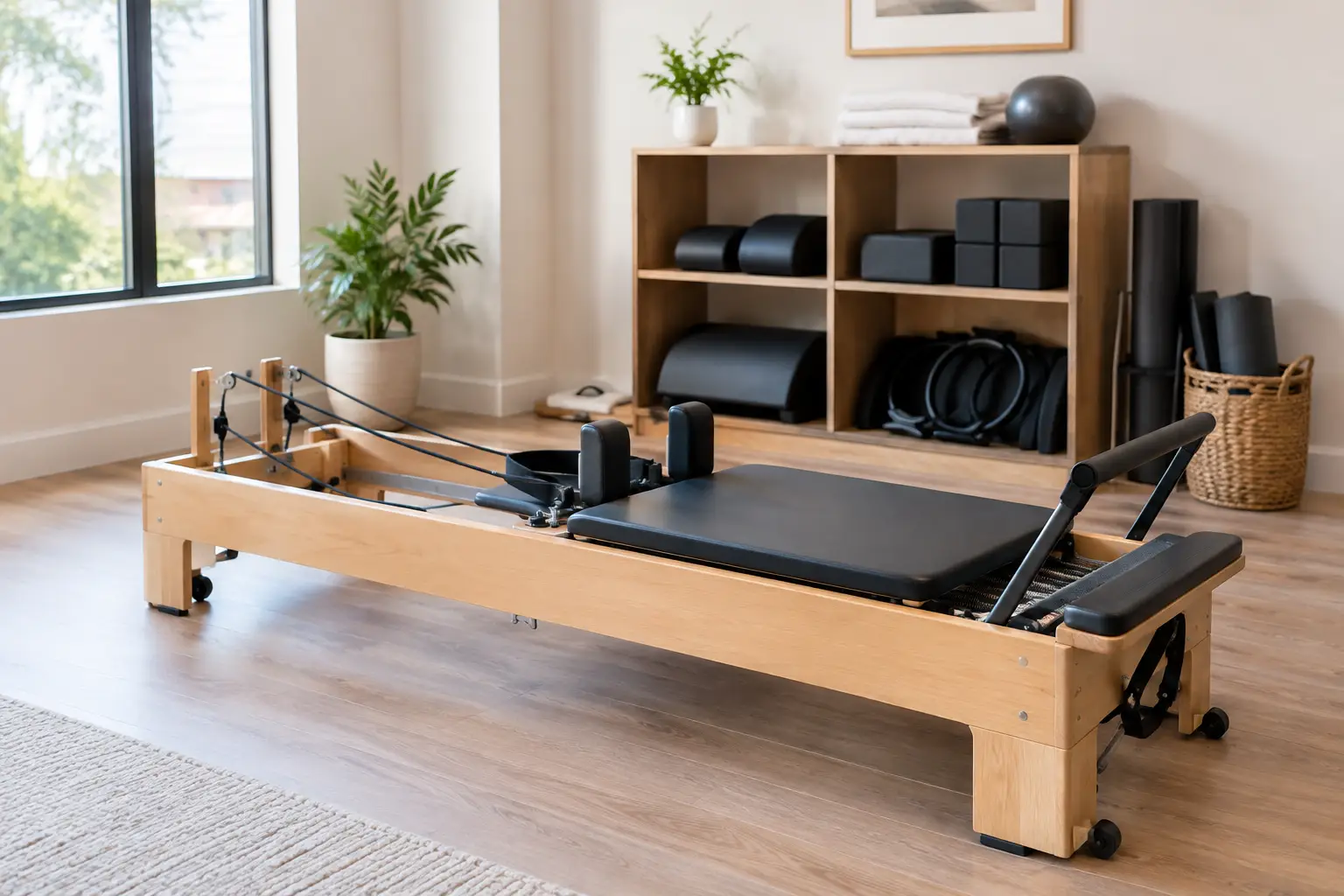
A reformer can support a remarkably consistent home Pilates practice, but only if it fits into your life between workouts. The most useful reformer storage examples account for more than the machine’s folded dimensions. They consider how often you plan to use it, who shares the room, whether you can move it comfortably, and whether putting it away will become one more reason to skip a session.
For many households, storage is not a minor product feature. It is the deciding factor between a reformer that becomes part of a sustainable routine and one that occupies a room without being used. Start with the way your home functions now, then choose a storage approach that protects both your space and your motivation.
Start With the Space You Need to Use a Reformer
Before planning storage, distinguish the reformer’s footprint from its workout footprint. A machine may be about 7 to 8 feet long when assembled, but you also need room to stand beside it, step on and off safely, change springs, and use accessories such as a jumpboard or box. A compact model may reduce the machine’s overall size, yet it still needs adequate clearance for a comfortable workout.
Measure the intended room with the reformer fully extended in mind. Check door swings, low shelves, ceiling fans, windows, radiators, and pathways that family members use throughout the day. If you are considering a folding model, measure the route from its workout location to its storage location as well. A reformer that must turn sharply through a narrow doorway or move over thick carpet may be harder to store than product photos suggest.
Weight matters, too. Some home reformers can be rolled by one person using transport wheels, while others are heavy enough that moving them regularly is unrealistic. Do not assume wheels mean effortless portability. Wheels are usually designed for short moves across a smooth floor, not repeated trips up stairs or across uneven surfaces.
Reformer Storage Examples for Common Home Layouts
The right solution depends on whether your reformer needs to disappear, share a room politely, or remain ready for daily practice. These examples offer a realistic starting point.
A vertical folding reformer in a small apartment
A vertical-storage reformer is often the strongest option for apartment living, particularly when the living room doubles as a workout space. After use, the frame folds and stands upright against a wall, typically on a stable base designed by the manufacturer. This can free much of the floor for normal daily life.
This setup works best when the wall is clear, the floor is level, and there is no risk of children, pets, or a swinging door knocking the stored machine over. It is also worth confirming the folded height before buying. A reformer that stores upright may still be too tall for a low-ceilinged room or awkward beneath a wall-mounted television.
Choose this arrangement if you value open floor space and are comfortable with a brief setup before each class. The trade-off is friction: even an easy fold-and-unfold process can feel less appealing on busy days than stepping onto a machine that is already prepared.
A folded reformer behind a sofa or in a guest room
In a one-bedroom home, a folding reformer can live behind a sofa, along the longer wall of a guest room, or beside a bed if the area stays accessible. This is a sensible approach for someone practicing two or three times a week who needs the room to serve other purposes.
Leave enough space to roll the reformer out without dragging it against furniture. A slim storage zone is useful, but it should not require moving several items before every workout. If you have to relocate a side table, floor lamp, and storage basket each time, the arrangement may look efficient on paper but become frustrating in real life.
Avoid storing a reformer flat under a bed unless the manufacturer specifically supports that position and the clearance is generous. Most reformers are too tall, long, or mechanically complex for under-bed storage. Forcing a machine into a tight spot can damage upholstery, snag straps, or make it difficult to retrieve safely.
A rolling reformer in a flex room
A flex room is often the ideal middle ground for a home reformer. Think of a spare bedroom, den, finished basement, or wide home office where the machine can remain assembled against one wall. You can roll it a few feet into a central workout position, then return it after practice without folding the frame.
This option is especially practical for a heavier non-folding reformer. It preserves quick access while allowing the room to remain functional for reading, work, or guests. Use a floor layout that keeps the carriage end clear and lets you approach the reformer from the side rather than squeezing between it and a wall.
If the floor is hardwood or tile, a protective mat can reduce scuffs and define the workout area. On carpet, test how easily the wheels move. Very plush carpeting may make routine repositioning more difficult than expected.
A dedicated wall zone in a bedroom
A bedroom reformer setup can work well for people who prefer private, quiet sessions and have enough open wall length. Rather than treating the reformer as something to hide, designate it as a permanent piece of wellness equipment. Keep it assembled parallel to a wall, with the footbar facing an open area and enough clearance for safe movement.
The visual effect matters here. A reformer with a clean frame, neutral upholstery, and organized accessories can feel intentional rather than intrusive. A small closed bin or cabinet for straps, loops, a ring, and cleaning supplies prevents the room from becoming cluttered.
The limitation is obvious: the reformer will shape the room’s layout. This is best for a primary bedroom with unused square footage, not a tight room where the machine blocks drawers, closets, or the path around the bed.
A permanent setup in a garage or basement gym
For households with a dedicated training area, leaving the reformer assembled is usually the lowest-friction choice. You can keep accessories nearby, maintain consistent lighting, and start a short session without setup time. That convenience can be worth more than a folding feature, particularly for experienced practitioners who use a reformer four or more times a week.
Temperature and moisture deserve attention. Garages and unfinished basements can expose upholstery, metal components, and wood frames to humidity, dust, or large temperature swings. Keep the machine off damp concrete if needed, clean it regularly, and follow the manufacturer’s care guidance. A garage is not automatically unsuitable, but it should be dry, reasonably clean, and comfortable enough that you will genuinely want to exercise there.
Check the Storage Claims Before You Buy
“Space-saving” can mean several different things. Some reformers fold in half. Others stand vertically. Some do neither but include wheels for rolling against a wall. Product descriptions may focus on compact storage without clearly stating whether the machine can safely stand upright, how much it weighs, or whether one person can manage the process.
Ask for three sets of measurements: assembled dimensions, folded or stored dimensions, and recommended operating clearance. Also look for the stated machine weight and the maximum user weight. A very lightweight frame may be easier to move, but it can feel less stable or less smooth than a heavier, more substantial reformer. Storage convenience is valuable, but it should not outweigh build quality, carriage feel, resistance range, and the kind of training you want to do.
If you expect to store the reformer vertically, use only the approved method in the owner’s manual. Do not lean a standard reformer against a wall simply because it appears narrow enough. The frame, springs, wheels, and carriage were not necessarily designed for that position.
Make Storage Part of Your Routine, Not a Daily Obstacle
The best storage plan is one you can repeat when you are tired, short on time, or finishing a workout before work. Keep the area around the machine clear, return accessories to the same place, and wipe down the carriage and handles before storing it. Small habits protect the equipment and make the next session easier to begin.
If your available space is limited, it may be wiser to choose a compact, easy-to-store reformer that you will use regularly than a larger studio-style model that demands a dedicated room you do not have. Better information leads to better Pilates choices, and in this case, an honest measurement of your home is just as valuable as any specification on a product page.
A reformer does not need a picture-perfect home gym to earn its place in your routine. It needs a safe location, a workable path in and out of storage, and enough ease that practice still feels like the simplest good decision of your day.
Leave a Reply
You must be logged in to post a comment.