A class can leave your legs shaking, your posture feeling taller, and your core working harder than expected. That does not mean every low-impact workout is doing the same job. In the barre versus Pilates decision, the better choice depends less on which method is more challenging and more on what you want your training to improve: muscular endurance, movement control, mobility, posture, or long-term strength.
Both formats can be effective, accessible ways to build a regular exercise habit. They also look similar from the outside. You may see small, precise movements, light equipment, focused instructors, and an emphasis on form. But their movement principles, training tools, and progression paths are meaningfully different.
Barre Versus Pilates: The Core Difference
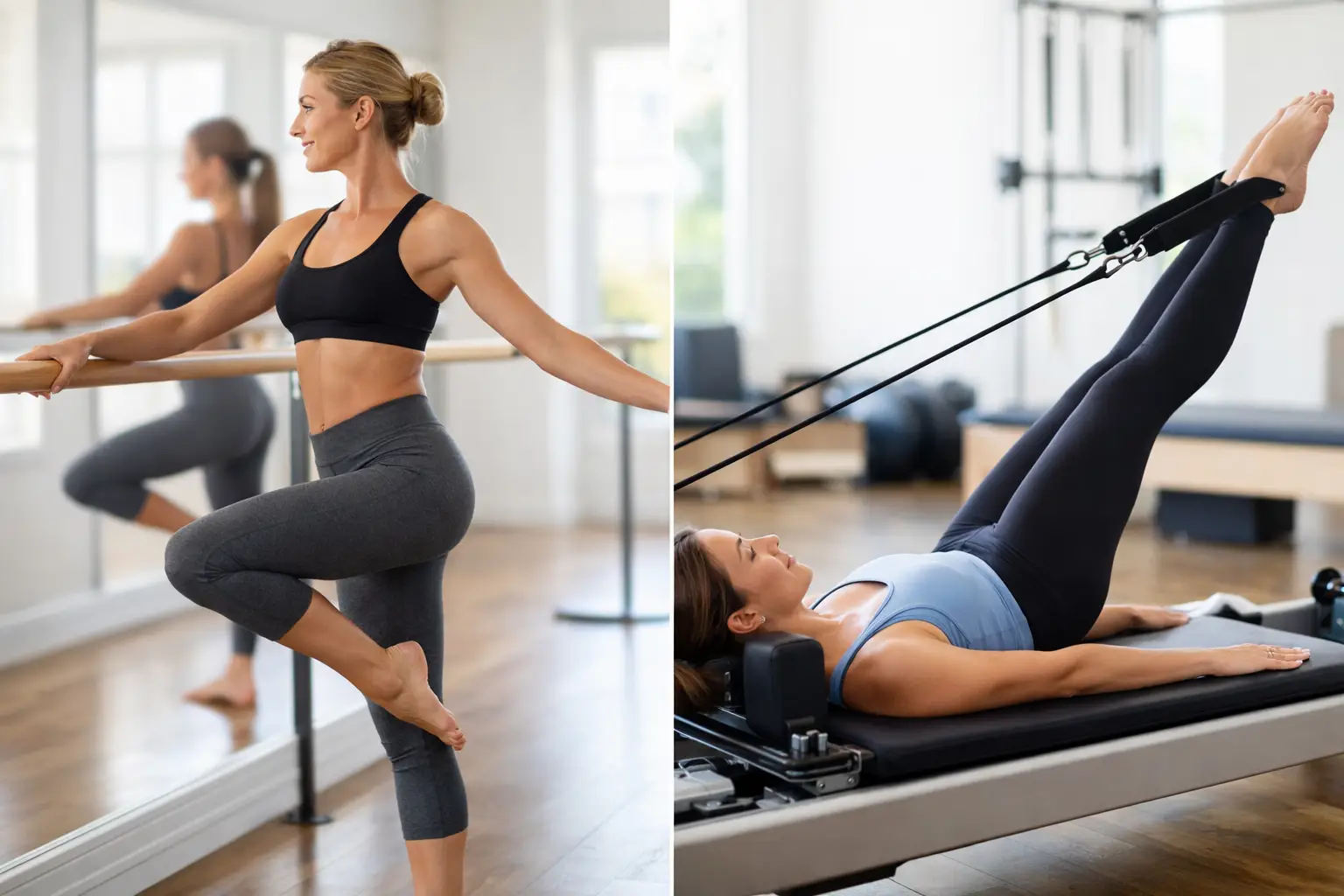
Barre is a fitness format influenced by ballet conditioning, along with elements of strength training and yoga. A typical class uses a ballet barre or chair for balance and includes high-repetition exercises such as pulses, holds, heel lifts, and small ranges of motion. You might use light hand weights, a ball, resistance bands, or gliders, but the emphasis is usually on sustained muscular work.
Pilates is a movement system developed by Joseph Pilates that centers on controlled, intentional exercises coordinated with breathing. It is practiced on a mat or on specialized equipment, including the reformer, chair, Cadillac, and barrels. Pilates asks you to organize your alignment, stabilize the trunk, and move the arms and legs with control rather than simply pushing through fatigue.
Neither approach is automatically better. Barre often appeals to people who enjoy a faster class rhythm and a clear muscle-burning sensation. Pilates may be a stronger fit for someone who wants to understand how their body moves, improve control through a fuller range of motion, or build a practice that can progress from beginner mat work to more substantial resistance training.
How Each Workout Feels in Practice
A barre class tends to move through body regions: legs, seat, arms, and core. The repetitions are high, and the goal is often to keep a muscle under tension long enough to create fatigue. The exercises can be deceptively difficult, particularly during isometric holds or repeated lower-body pulses. While good instructors offer modifications, the pace may feel demanding for a true beginner or anyone returning to exercise after time away.
Pilates is generally less about chasing a burn and more about quality of movement. That does not make it easy. A controlled bridge, side-lying leg series, or plank variation can reveal weak links in the hips, trunk, or shoulder girdle quickly. The difference is that Pilates typically gives more attention to setup, breathing, and how one area of the body influences another.
On a reformer, springs create adjustable resistance and feedback. The moving carriage can make exercises more challenging, but it can also support certain movements better than the floor. For example, a reformer may help a beginner learn controlled leg work while giving an experienced practitioner enough resistance to make the same movement demanding.
Intensity Is Not the Same as Effectiveness
Barre’s high repetitions can produce a strong immediate sensation of effort. This is useful if that feeling motivates you to return to class. Still, shaking muscles are not the only marker of a productive workout. A well-designed Pilates session may feel quieter while requiring substantial concentration, strength, and coordination.
If your goal is cardiovascular conditioning, neither traditional barre nor Pilates should necessarily be your only form of exercise. Some classes are intentionally fast-paced, but walking, cycling, swimming, or other aerobic training may still have an important place in your routine. The most useful plan is one you can recover from and repeat consistently.
Benefits: Where Barre and Pilates Overlap
Both barre and Pilates can support better body awareness, balance, posture, and muscular endurance. They are typically low impact, which makes them appealing for people who do not enjoy jumping or high-intensity interval training. Both can also be adapted with lighter resistance, smaller ranges of motion, or additional balance support.
The overlap, however, should not obscure the tradeoffs. Barre’s lower-body focus can be especially satisfying for people who want a concentrated leg and glute workout. It may also feel socially energizing in a studio setting, where music and group pacing help carry the session forward.
Pilates is especially well suited to building a more connected understanding of the core, hips, spine, and shoulders. Here, “core” does not mean continually tightening your stomach. It refers to coordinated support from the trunk, pelvis, diaphragm, and surrounding musculature as you move. That focus can make Pilates valuable for people who spend long periods sitting, notice recurring stiffness, or want to improve movement quality alongside strength.
For bone health and maximal strength, consider what is missing rather than expecting either format to cover every need. Light weights and bodyweight work can contribute to strength, but progressive heavy resistance and impact-based activity may be appropriate additions for many adults, depending on their health status and clinician guidance.
Equipment, Access, and Cost Considerations
Barre is comparatively simple to do at home. You can begin with a stable chair or countertop, a mat, and little else. A small ball, loop band, and light dumbbells can add variety, but they are not required. The main safety consideration is using a support surface that will not slide, tip, or force you into an awkward position.
Mat Pilates is also accessible and requires minimal space. A supportive mat and perhaps a resistance band or Pilates ring are enough for many beginner sessions. The learning curve matters, though. Without clear instruction, it is easy to rush through exercises, hold unnecessary tension in the neck, or work in a range of motion that does not suit your body.
Reformer Pilates requires a larger financial and space commitment. A home reformer can provide versatile resistance and a wide exercise library, but models vary significantly in carriage length, frame stability, spring system, weight capacity, folding design, and included accessories. A lower price does not automatically mean poor value, but it should prompt a closer look at whether the machine supports your height, intended use, and long-term training goals.
A reformer is most worthwhile when you expect to use it regularly and appreciate equipment-based Pilates specifically. It is not necessary to get real benefits from Pilates. Starting with mat work or instructor-led sessions can help you decide whether the method fits your routine before making a major purchase.
Which Is Better for Beginners?
A beginner can start with either barre or Pilates, provided the instructor offers thoughtful modifications and encourages form over performance. The more useful question is what kind of beginner you are.
Choose barre if you like a structured, upbeat workout, enjoy repetition, and want a simple way to build lower-body muscular endurance. Look for a class that explains alignment clearly rather than treating discomfort as proof that you are working hard enough.
Choose Pilates if you want to build foundational movement skills, prefer a measured pace, or are interested in eventually using a reformer. Pilates can be a practical entry point for someone who wants to work on posture, trunk stability, and mobility with room to progress gradually.
If you have persistent pain, recent surgery, pregnancy-related considerations, osteoporosis, or a medical condition that affects exercise, individual guidance is more useful than a generic class modification. A qualified healthcare professional or appropriately trained movement instructor can help you decide which exercises and ranges are suitable.
Can You Do Both?
Yes. Many people use barre and Pilates as complementary practices. Barre can add variety and a strong muscular-endurance challenge, while Pilates can reinforce the control and alignment that make other workouts feel better. You might take one barre class each week and complete two Pilates sessions, then add walks or strength training based on your schedule and priorities.
The key is avoiding an all-or-nothing approach. If barre leaves your hip flexors or knees irritated, reduce frequency or adjust the exercises rather than assuming you need to push harder. If Pilates feels too subtle at first, give yourself time to learn the method, then increase resistance, complexity, or session frequency with intention.
Your best choice is the practice you can perform with good form, recover from well, and return to next week. Start with the format that matches your current goals, then let your experience guide the next decision. Better information leads to better Pilates choices, but your body’s feedback belongs in the decision too.