
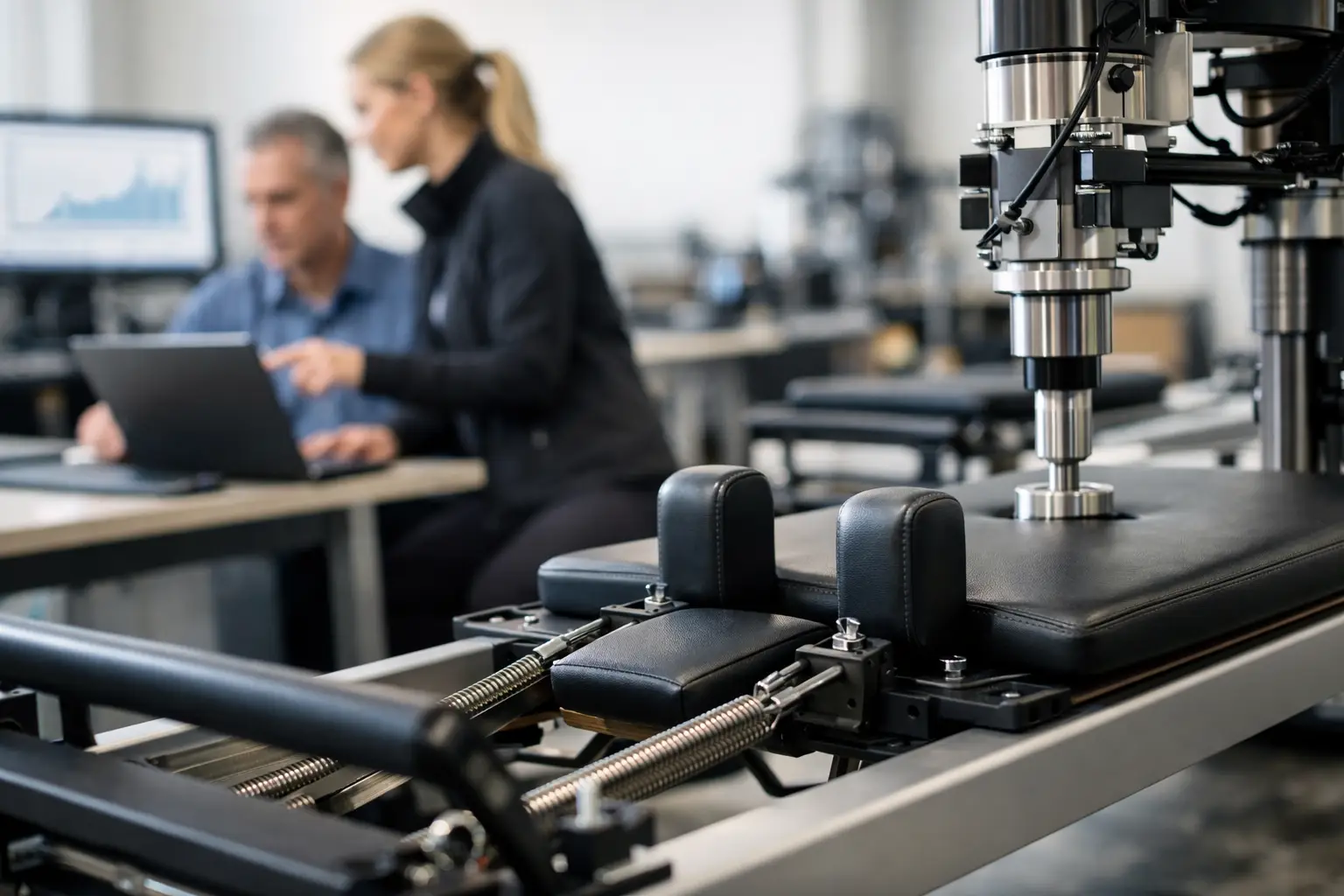
A reformer can look polished in a product photo and still develop a noisy carriage, loose fittings, or uneven resistance after a year of regular use. That is why reformer durability testing results matter more than a brand’s broad promise of “commercial quality.” For a home buyer, the useful question is not simply whether a machine can support your current workouts. It is whether it can continue to feel safe, stable, and pleasant to use as Pilates becomes part of your weekly routine.
Durability is also rarely captured by one specification. A higher weight capacity may indicate a strong frame, but it does not tell you how well the wheels track, whether spring hooks resist wear, or how the upholstery holds up against sweat, friction, and cleaning. Better information leads to better Pilates choices, especially when a reformer is a significant home investment.
What Reformer Durability Testing Results Should Measure
Credible durability testing looks at how a reformer performs after repeated loading and movement, rather than how it feels during one fresh-from-the-box session. For home use, the most meaningful tests simulate the actions that create wear: sliding the carriage thousands of times, changing springs repeatedly, applying force through the footbar, and moving or storing the machine.
A useful testing report should explain the conditions, not just state that a reformer “passed.” Look for the amount of weight used, the number of movement cycles, whether the machine was loaded evenly and unevenly, and what changed afterward. A frame that stays intact but develops wheel noise or noticeable side-to-side carriage play has not delivered a clean durability result from an owner’s perspective.
Frame and structural stability
The frame is the foundation of the reformer. Testing should assess whether the rails remain aligned, whether welded joints or bolted connections loosen, and whether the machine rocks when force is applied through the footbar, shoulder rests, or standing platform.
Material matters, but it is not the whole story. Steel frames generally offer excellent rigidity and can be a sensible choice for frequent use. Aluminum can also be durable while keeping the reformer easier to move. With wood models, the quality of the hardwood, joinery, finish, and hardware matters far more than the fact that the frame is wood. A well-made hardwood reformer can last for many years, while a poorly constructed one may shift or creak around connection points.
Pay close attention to stability under asymmetrical load. Pilates is not always perfectly centered. You may stand on one side during a lunge, press through one foot in a single-leg exercise, or sit slightly off-center during transitions. The reformer should remain planted and composed, not twist, lift, or slide across the floor.
Carriage, rails, and wheel wear
The carriage system is where daily use becomes most noticeable. It should travel smoothly without catching, rattling, or drifting to one side. Durability testing should assess wheel compression, bearing condition, rail wear, and carriage alignment after extended cycling.
A quiet carriage is appealing, but sound alone is not a complete quality marker. Some wheel materials are naturally quieter than others, and a reformer may become louder because its rails need cleaning rather than because it is failing. More concerning signs include a carriage that feels rough after cleaning, visible flat spots on wheels, wobble at the end of the glide, or rails that show premature scratches or grooves.
For most home users, a reformer with a serviceable wheel system has an advantage over one with parts that are difficult to replace. Wear items eventually wear. Long-term value depends partly on whether the manufacturer has made reasonable maintenance and repair possible.
Springs, ropes, and moving hardware
Resistance systems deserve close attention because they affect both workout quality and safety. Metal springs should return smoothly to their resting length and show no corrosion, gaps, distortion, or weakened attachment points. Testing should include repeated extension and release, as well as regular spring changes, since spring hooks and gear bars receive a great deal of contact over time.
Ropes, straps, pulleys, and risers should also be evaluated as a system. Fraying ropes, sticky pulleys, or hardware that shifts during use can interrupt an otherwise well-built reformer. This is one area where maintenance requirements are normal, not a flaw. Ropes and straps are consumable components, particularly in busy households. What matters is whether they are easy to inspect, adjust, and replace according to the brand’s guidance.
How to Read Results When Brands Share Limited Data
Many consumer reformer brands do not publish laboratory-style durability reports. That does not automatically mean their equipment is poor. It does mean you should avoid treating vague phrases such as “tested for performance” as meaningful proof.
When formal data is limited, build a more complete picture from the details that are available. Review the stated user weight limit, warranty terms, replacement-part availability, assembly design, and owner feedback collected over time. A three-day review can describe first impressions; a review written after six months is more likely to reveal wheel noise, upholstery wear, shifting alignment, or frustrating customer service.
Manufacturer warranty language can be especially revealing. Frame coverage is often longer than coverage for wheels, springs, upholstery, ropes, and other moving components. That distinction is reasonable because these parts have different wear patterns. Still, a short or unclear warranty on essential mechanical parts should factor into your decision, particularly if you expect to use the reformer four or more times each week.
Be cautious with testimonials that describe a machine as “sturdy” without explaining how it has been used. A compact reformer used twice a week for gentle mobility work faces very different demands than the same model used daily for athletic strength sessions by more than one person.
The Home-Use Factors That Change the Result
A reformer’s real-world lifespan depends on its environment as much as its construction. A machine can perform well in testing and still wear early if it is stored in a damp basement, placed on an uneven floor, or repeatedly moved by lifting it from the wrong point.
Your body size, workout style, and household usage all matter. A beginner practicing controlled foundational work may place less stress on the machine than an experienced user who performs jumping, long-stretch variations, or frequent standing work. None of those exercises are inherently a problem on an appropriately rated reformer, but they make frame stability, footbar security, and carriage tracking more consequential.
Storage is another trade-off worth considering. Foldable and vertical-storage reformers can make home Pilates far more realistic in a small space, but their hinges, locking mechanisms, and transport wheels add components that need inspection. A fixed studio-style reformer may have fewer moving structural parts, yet it requires a dedicated footprint. The right choice depends on whether convenience will help you practice consistently and whether you are willing to follow the storage instructions every time.
A Practical Durability Checklist Before You Buy
Before committing, ask the seller or manufacturer direct questions. The answers can be more useful than polished marketing language:
- What testing was performed on the frame, carriage, springs, and footbar, and under what load or cycle conditions?
- Which parts are considered normal wear items, and what do replacements typically involve?
- Is the carriage wheel system adjustable or serviceable if it becomes noisy or misaligned?
- What does the warranty cover separately for the frame, moving parts, and upholstery?
- Are replacement springs, ropes, straps, wheels, and hardware available for the expected life of the model?
Also confirm the reformer’s dimensions, weight, and setup requirements before it arrives. A durable machine that cannot sit level in your intended room, or that is too heavy for you to reposition safely, may create problems that have nothing to do with its build quality.
Durability Is About the Experience Over Time
The best reformer is not necessarily the heaviest, the most expensive, or the one with the longest feature list. It is the model whose construction matches how you plan to use it, whose wear components can be maintained realistically, and whose support policies remain useful after the initial purchase period.
When comparing reformer durability testing results, favor specific evidence over broad claims and consider the entire ownership experience. A well-supported reformer that stays aligned, moves smoothly, and can be maintained without guesswork makes it easier to return to your practice week after week. That consistency is where a thoughtful equipment decision begins to pay off.