A Pilates workout can look deceptively simple: a bridge held for a few breaths, a controlled leg reach, a carriage gliding back and forth. Yet the difference between merely copying the shape and getting the intended benefit lies in the Pilates foundations underneath it. These principles help you build strength without rushing, improve body awareness without overcorrecting, and create a home practice that can grow with you.
For beginners, this matters more than memorizing a long list of exercises. Pilates is not designed around doing the most repetitions or using the heaviest resistance. It asks you to organize your body, pay attention to how you move, and choose a level of challenge you can control. That approach makes it useful for people returning to exercise, building a consistent routine, or considering whether a reformer belongs in their home.
What Pilates Foundations Actually Mean
Pilates foundations are the movement skills and method principles that make exercises effective. They include breath, concentration, control, alignment, precision, and a flowing quality of movement. You may see these described as the six principles of Pilates, although language varies by teacher and training tradition.
The point is not to perform each principle perfectly. Bodies differ, and a cue that helps one person can feel distracting or uncomfortable to another. The goal is to use these ideas as a practical framework. Before adding range of motion, springs, or faster transitions, you learn to notice what your ribs, pelvis, shoulders, and spine are doing.
This is one reason Pilates can feel challenging even when the movement is small. A slow heel slide that keeps the pelvis stable may require more attention than a larger, faster exercise. Progress is often less visible than adding weight to a barbell, but it can be highly meaningful: steadier balance, less gripping through the neck, better control on stairs, or greater confidence moving through daily life.
The Core Skills Behind Pilates Foundations
Breath creates useful support
Pilates breathing is often described as lateral or three-dimensional breathing. Rather than forcing the belly to stay completely still, you aim to let the rib cage expand through the sides and back as you inhale. On the exhale, the abdominal wall gently responds and the ribs soften down without being aggressively pulled in.
This is not a contest to make your stomach as flat as possible. Over-bracing can make movement stiff and may lead you to hold your breath. A more useful goal is pressure management: breathing steadily while your trunk provides enough support for the task at hand.
If coordinated breath feels confusing, simplify it. Inhale to prepare. Exhale during the part of the movement that requires the most effort, such as lifting into a bridge or pressing the reformer carriage away. Consistent breathing is more valuable than following a complicated pattern you cannot maintain.
Alignment gives you a starting point, not a rigid pose
In Pilates, alignment refers to how body segments relate to one another during a movement. A neutral pelvis and spine are common starting points, but neutral is not a single fixed shape. Your natural spinal curves, hip structure, mobility, and comfort all affect what neutral looks like for you.
Good instruction should help you avoid collapsing into joints, twisting unintentionally, or loading one side much more than the other. It should not ask you to force your back flat, tuck your pelvis constantly, or pull your shoulders down with tension. Sometimes a gentle pelvic tilt is appropriate. Sometimes allowing the spine to round or extend is the exercise. Context matters.
At home, a mirror can offer occasional feedback, but it is easy to become overly visual. Pay attention to sensation as well. If an exercise is meant to challenge your hips but you only feel it in your low back or neck, reduce the range, change the setup, or ask a qualified instructor to assess your form.
Centering is coordination, not constant squeezing
The “core” in Pilates includes more than the abdominal muscles. It involves the diaphragm, deep abdominal muscles, muscles around the pelvis and hips, the back, and the way these areas coordinate with the rest of the body.
Centering does not mean clenching your pelvic floor or gripping your abs at maximum effort throughout an entire session. For many people, especially those who already carry tension, that cue is not helpful. Think instead of creating a gently responsive center that can stabilize while your arms and legs move.
A simple test is whether you can still breathe and relax your jaw. If not, the effort may be too high for the current variation. Reducing lever length, using lighter reformer springs, or placing your feet on the floor can preserve the purpose of an exercise while making it more manageable.
Control and precision make resistance productive
Pilates uses resistance to reveal habits. On a reformer, springs can assist a movement, challenge it, or both. A heavier spring is not automatically harder. For example, more spring tension may make the carriage feel more stable in one exercise but demand more control as you return it home.
Control means moving at a pace where you can maintain your intended alignment and breath. Precision means making a clear choice about the movement rather than letting momentum take over. This is why a smaller range can be the right progression, not a lesser version.
For mat Pilates, the same rule applies. If lowering your legs causes your ribs to flare or low back to strain, keep the legs higher. If a plank causes shoulder discomfort, use an incline or knees-down setup. Pilates is adaptable by design, and smart modifications are part of the method.
Flow connects the work to real movement
Flow is often mistaken for moving quickly. In practice, it means avoiding unnecessary stops, resets, and tension while transitioning with purpose. You may work slowly, especially as a beginner, and still develop flow by moving with a steady rhythm.
This quality matters because daily movement rarely happens one muscle at a time. Getting up from the floor, carrying groceries, reaching overhead, and walking all ask the body to coordinate multiple areas at once. Pilates training can help you practice that coordination in a more focused setting.
How to Build a Foundation at Home
A sustainable home routine should be modest enough to repeat. Two or three sessions a week of 20 to 30 minutes can be more useful than an ambitious schedule that disappears after two weeks. Start with a small group of movements that teach key patterns: pelvic and rib awareness, spinal mobility, hip extension, side-lying hip work, supported abdominal control, and upper-body stability.
Choose instruction that explains why an exercise is being done and offers options for different bodies. A class that moves too quickly may be enjoyable once you know the method, but it can make foundational learning harder. Pausing a video, repeating one movement, and taking notes on useful cues are reasonable ways to learn.
Basic equipment can support consistency without turning your living room into a studio. A supportive mat, small towel, light resistance band, or Pilates ball can add variety. Equipment is only helpful when it clarifies the work rather than adding complexity. A band that pulls you out of alignment or a ball that makes you grip is not improving the exercise.
When a Reformer Fits Into the Picture
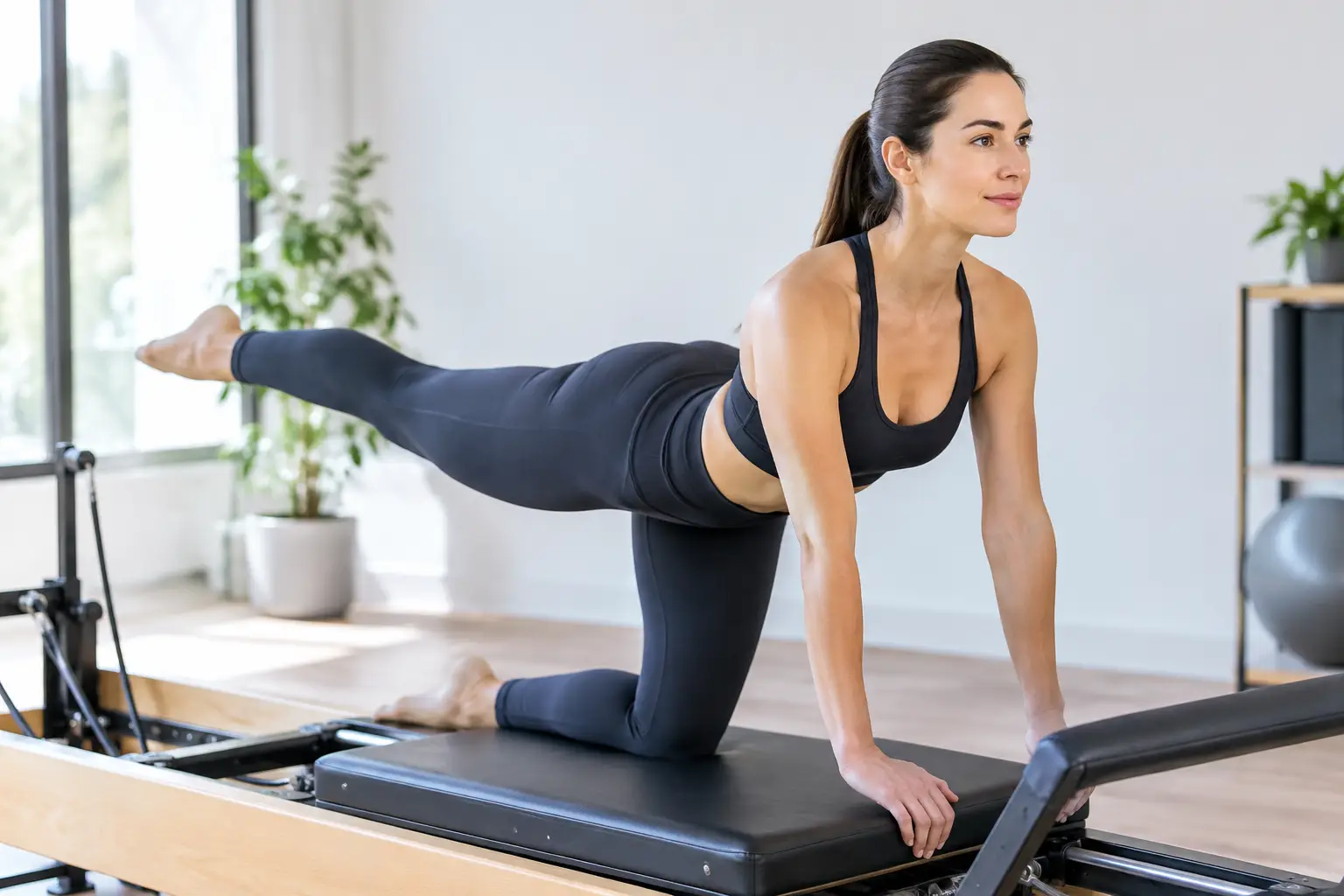
A reformer can be an excellent teaching tool because the carriage, springs, footbar, and straps provide feedback. You can feel when the carriage shifts, when one leg presses harder, or when shoulder tension interferes with a pulling exercise. It also offers a wide range of positions, including supported options for people who find getting down to and up from the floor difficult.
Still, a reformer does not replace Pilates foundations. Without basic awareness, it is possible to use the machine as a way to push harder while missing the control that makes the work valuable. Beginners often benefit from a few instructor-led sessions or a carefully structured beginner program before relying on independent reformer workouts.
If you are considering a home reformer, evaluate more than the class content you hope to take. Measure the usable floor area, including space around the machine and the room needed to extend it. Consider carriage length, weight capacity, spring system, frame stability, storage requirements, and whether the included accessories match your likely use. A compact folding model may be practical for a multipurpose room, while a heavier studio-style frame can offer a more planted feel and broader exercise range. The right choice depends on your space, budget, body size, and how often you realistically expect to use it.
Common Mistakes That Slow Progress
The most common mistake is treating Pilates as a performance. Holding the breath, forcing flexibility, or chasing the deepest range can make an exercise look advanced while reducing its benefit. Another is assuming soreness is proof of a productive session. Some muscle fatigue is normal, but sharp pain, numbness, joint pain, or symptoms that worsen afterward are signals to stop and seek appropriate guidance.
It is also easy to overfocus on one area, usually the abs. Pilates can strengthen the trunk, but its value comes from whole-body organization. Hip strength, foot stability, shoulder mechanics, spinal movement, and balance all influence how supported your center feels.
Finally, avoid changing every variable at once. When an exercise becomes easy, progress one element: add a repetition, lengthen a lever, reduce support, slow the tempo, or adjust resistance. This makes it easier to understand what your body is responding to and keeps your practice from becoming needlessly complicated.
The best Pilates practice is not the one with the most difficult exercises or the most expensive equipment. It is the one you can return to with attention, appropriate challenge, and enough curiosity to notice that stronger, more comfortable movement is being built one controlled repetition at a time.
Leave a Reply
You must be logged in to post a comment.