
A good Pilates progression plan does not ask you to chase the most advanced exercise in the shortest possible time. It gives you a reliable way to build control, strength, mobility, and confidence without turning your home practice into a guessing game. The goal is not simply to make exercises harder. It is to make your movement more precise, better supported, and more useful in everyday life.
For many home practitioners, progression becomes confusing because Pilates can look deceptively simple. A movement may have a small range of motion yet demand considerable abdominal support, hip stability, shoulder organization, and breath control. Adding springs, repetitions, or complex choreography before those elements are in place can make the workout feel harder, but not necessarily better.
Start With a Clear Baseline
Before planning what comes next, identify what your body can do consistently now. A baseline is not a test you need to pass. It is a practical snapshot that helps you choose an appropriate starting point.
For the first two or three weeks, notice how you handle foundational work: pelvic tilts, bridge variations, chest lifts, toe taps, side-lying leg work, quadruped arm and leg reaches, and basic plank preparation. On a reformer, that may include footwork, bridges, feet-in-straps work, seated rowing, and an introductory long stretch or kneeling arm series.
Look beyond whether you can complete the exercise. Ask whether you can keep a steady breath, avoid gripping in the neck or hip flexors, and maintain control through the return. If your low back arches during toe taps or your shoulders rise toward your ears during arm work, that is useful information. It usually means the exercise needs a smaller range, less load, or a simpler variation for now.
This approach is especially valuable if you are returning to movement after pregnancy, an injury, a long break, or a period of high stress. Progress is rarely linear in those situations. Some sessions will call for more support, not more challenge.
The Four Stages of a Pilates Progression Plan
A practical plan usually moves through four overlapping stages: learn the movement, build consistency, add challenge, and integrate more complex work. You do not need to complete every exercise in one stage before moving on. Instead, use the stages to make decisions exercise by exercise.
1. Learn position, breath, and control
At the beginning, prioritize setup. Learn where your pelvis, rib cage, head, and shoulders feel most supported. Practice breathing without forcing your ribs down or pulling your stomach in as tightly as possible. Pilates core work is about coordinated support, not constant bracing.
Use modifications freely. Keep both feet on the floor for abdominal work, bend the knees in a plank, reduce the range of a roll-up, or use lighter reformer springs when they allow you to move with more control. A modification is not a lesser version of Pilates. It is often the version that gives your body the clearest feedback.
Aim for two or three sessions per week of 20 to 30 minutes. At this stage, repeating a short routine is more productive than sampling a new workout every day. Familiarity helps you notice meaningful improvements in alignment and control.
2. Build consistency and capacity
Once the basic positions feel familiar, gradually increase the amount of quality work you can perform. This may mean adding a set, extending a hold by a few breaths, or moving from one weekly full-body session to two or three.
The key word is quality. If you can perform eight controlled bridges with even weight through both feet, you might work toward 10 or 12. If the final repetitions change your pelvic position or create low-back discomfort, keep the lower number and revisit it next week.
On a reformer, capacity can develop through a slightly longer footwork series, more deliberate carriage control, or a carefully chosen spring change. More resistance is not automatically more advanced. Heavy springs can support certain exercises, while lighter springs may create a greater stability challenge. The right choice depends on the movement, your equipment, and your ability to keep the carriage controlled.
3. Add range, leverage, or resistance
After you can repeat foundational movements with consistent form, introduce one variable at a time. You might increase range of motion, lengthen the lever, reduce external support, slow the tempo, or add moderate resistance.
For example, a bent-knee toe tap can progress to a longer lever with the leg reaching farther away, provided your pelvis and rib cage remain stable. A bridge can progress from two feet to marching, then eventually to a single-leg variation if both hips stay level. On the reformer, a stable feet-in-straps series may progress through a larger circle or a more demanding spring setting, but not both on the same day.
Changing one variable makes it easier to understand what your body is responding to. If you alter the spring load, range, tempo, and repetition count all at once, it becomes difficult to tell whether the challenge is appropriate or simply too much.
4. Integrate complex patterns
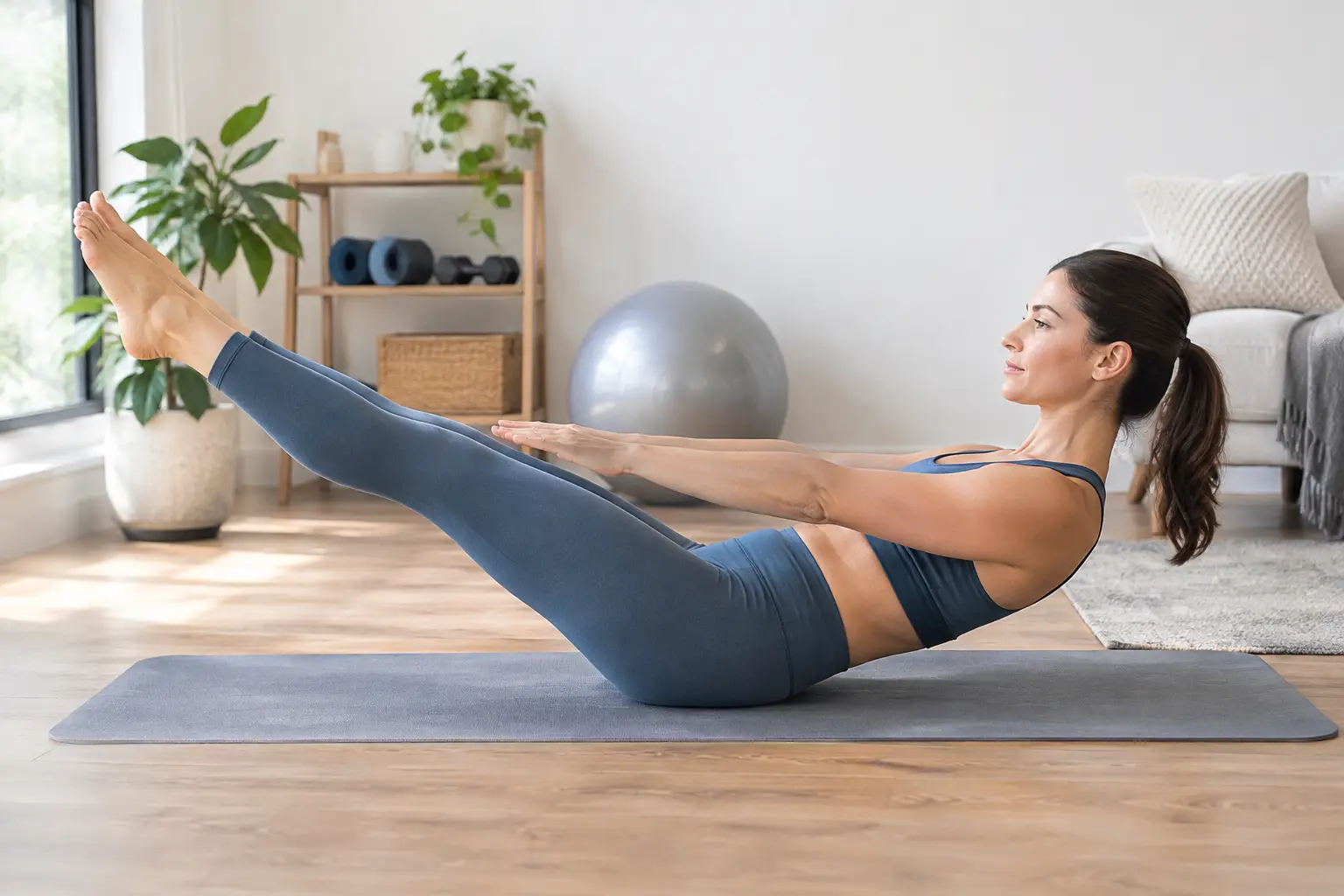
Advanced Pilates is often less about dramatic shapes and more about maintaining organization during demanding transitions and full-body patterns. Exercises such as long stretch variations, side plank work, teaser progressions, standing reformer sequences, and unilateral leg work ask multiple systems to cooperate at once.
These movements can be rewarding, but they are not mandatory milestones. A strong, sustainable practice may include simple footwork, bridges, rows, and mat-based core training for years. Complex exercises are worthwhile when they serve your goals, feel appropriate for your body, and can be performed without compensating through the neck, low back, or joints.
How to Know When to Progress
Use a few practical markers rather than relying on a calendar alone. You are generally ready to progress an exercise when you can complete your planned repetitions with steady breathing, controlled tempo, and no increase in joint pain. You should also be able to maintain the intended position on both sides, even if one side still feels less coordinated.
Muscular effort is expected. Sharp pain, pinching, numbness, dizziness, or symptoms that linger after practice are not signs to push through. Return to a simpler option and consider guidance from a qualified Pilates instructor or health professional, particularly if you have a diagnosed condition, recent surgery, or persistent pain.
It also helps to distinguish challenge from fatigue. If an exercise becomes sloppy only at the end of a long workout, the answer may be to place it earlier in the session, not to abandon it. If it feels unstable from the first repetition, reduce the challenge immediately.
A Realistic Weekly Structure
For most people practicing at home, three focused sessions per week is enough to create noticeable progress. One session can emphasize foundational strength and mobility, another can focus on full-body flow and endurance, and a third can revisit areas that need more attention, such as hip stability, upper-back strength, or trunk control.
Keep at least one session deliberately manageable. A practice that leaves you feeling more connected and mobile has value, even if it does not feel intense. This is one reason Pilates can fit well alongside walking, strength training, cycling, or other movement you enjoy.
If you own a reformer, combine it with mat work rather than treating the machine as the only path forward. Mat sessions build body awareness with minimal setup, while reformer sessions offer adjustable resistance and feedback from the moving carriage. For some households, that flexibility makes a reformer a worthwhile long-term purchase. For others, a consistent mat practice is the more sensible starting point until space, budget, and training habits are clear.
Track What Actually Changes
A simple practice note can make progress easier to see. Record the exercises that felt stable, the variations that caused compensation, spring settings used on the reformer, and any discomfort. You do not need to document every session in detail. A few lines once a week is enough.
Pay attention to outcomes beyond appearance or exercise difficulty. You may notice that sitting at a desk feels less stiff, stairs feel easier, your balance improves, or you recover more quickly after a long day. Those changes often reflect the kind of durable progress Pilates is designed to support.
Your plan should remain adjustable. Sleep, travel, stress, menstrual-cycle changes, and other training all affect how much challenge makes sense on a given day. Moving back to a foundational variation is not losing progress. It is how you protect the consistency that creates it.
The best next step is usually the one that lets you finish a session feeling capable enough to return to it. Build from there, with patience and clear standards, and your home Pilates practice can become both stronger and easier to sustain.
Leave a Reply
You must be logged in to post a comment.